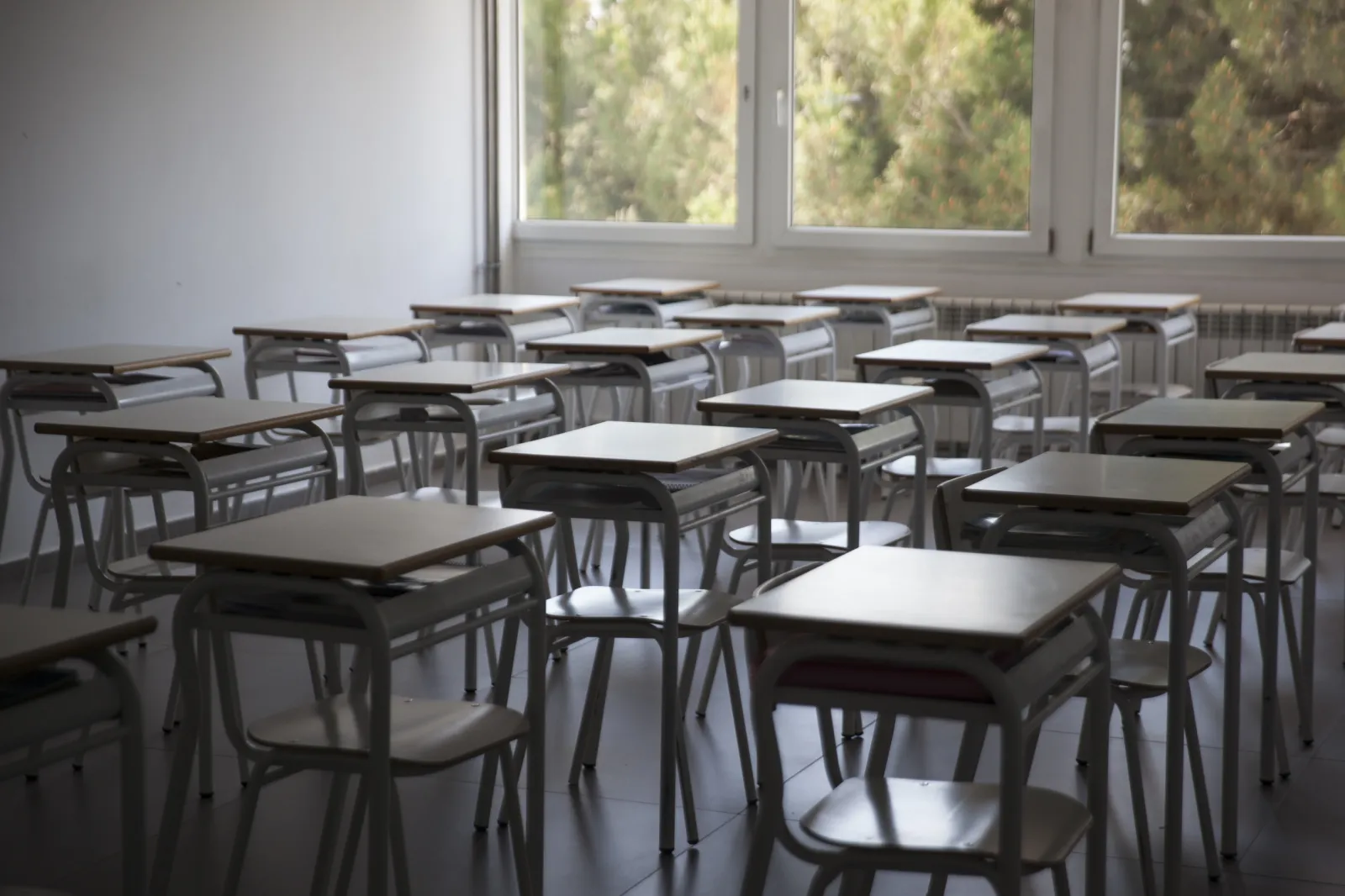

A teacher at Branch School No. 5 in Lunawada, Mahisagar district, Gujarat, has been suspended after an education-department inquiry into the alleged physical assault of a Class 5 student who reportedly had not brought his homework. The local report says the student suffered injuries on his back, including an injury reportedly caused by the teacher’s ring, following which education officials investigated the complaint and ordered the teacher’s suspension and departmental proceedings.
Introduction
A teacher in Lunawada, Mahisagar district of Gujarat, has been suspended following an inquiry into the alleged physical assault of a Class 5 student, according to a report published on September 27, 2026.
The incident reportedly took place at Branch School No. 5 in Lunawada after the student did not bring assigned homework to school. The report says the child later complained of pain and injuries were noticed on his back. A subsequent complaint by the family and a video of the dispute reportedly brought the matter to the attention of higher education authorities.
The Mahisagar education department then reportedly sent officials to the child’s home to examine the circumstances. The inquiry report, as described by Gujarat First, found that the student had been physically beaten and that a metal ring worn by the teacher allegedly caused an injury.
The teacher, identified in the report as Riyaz Daval, was subsequently suspended, with departmental proceedings ordered.
The case has also brought renewed attention to India’s legal prohibition on physical punishment in schools. Under Section 17 of the Right of Children to Free and Compulsory Education Act, 2009, children cannot be subjected to physical punishment or mental harassment, and violations can result in disciplinary action under applicable service rules.
What Happened?
The incident was reported from Branch School No. 5 in Lunawada, the headquarters town of Mahisagar district.
According to the September 27 report, the dispute began after a student allegedly failed to bring homework assigned by the school.
The report says the teacher, identified as Riyaz Daval, physically punished the student in the classroom. After returning home, the child reportedly complained of pain in his back, prompting the family to examine the injury.
The family subsequently approached the school and raised the matter with the principal. The report also says a video showing the confrontation at the school circulated on social media.
The incident then reached higher education authorities in Mahisagar.
Officials reportedly visited the child’s home as part of their inquiry and examined the circumstances surrounding the alleged assault.
According to the local report, the investigation found injuries on the child’s back and concluded that the teacher had physically assaulted the student. The report further states that the teacher’s metal ring struck the child’s back during the alleged assault and caused an injury.
Following the inquiry, the education department ordered the teacher’s suspension and departmental proceedings.
Key Details of the Mahisagar School Incident
The main facts reported so far are:
- Location: Branch School No. 5, Lunawada, Mahisagar district, Gujarat.
- Student: A Class 5 student, according to the news report supplied for this story.
- Reported trigger: The student allegedly failed to bring homework.
- Teacher named in the report: Riyaz Daval.
- Alleged injury: Injuries were reported on the student’s back.
- Education department action: The teacher was suspended.
- Further action: Departmental proceedings were ordered, according to the report.
- Inquiry: Education officials reportedly visited the child’s home and examined the complaint.
The available report does not establish that a criminal conviction has occurred. The suspension is an administrative action following the education department’s inquiry.
That distinction is important when reporting allegations involving an individual.
How the Complaint Reached Education Officials
The sequence described in the local report indicates that the matter moved from the family to the school and then to education authorities.
After the student reportedly returned home with pain and visible injuries, the parents became concerned and approached the school.
The report says a number of parents subsequently reached the school premises and raised the issue with the principal. A video of the confrontation reportedly circulated on social media, increasing attention around the incident.
The matter was then brought to the attention of higher-level education officials.
Rather than relying only on the video or the family’s account, officials reportedly visited the child’s home and conducted an inquiry.
According to the report, the findings of that inquiry led to disciplinary action against the teacher.
What the Education Department Did
The most significant official action reported so far is the suspension of the teacher.
Gujarat First reported that the education department ordered Riyaz Daval’s suspension with immediate effect and initiated departmental proceedings.
A suspension is an administrative measure. It should not by itself be interpreted as a final judicial finding of criminal guilt.
The next stage is the departmental process, through which the authorities can examine the allegations and determine appropriate action under the applicable service rules.
The publicly available report does not provide the complete departmental order or a final outcome of that proceeding.
What Does Indian Law Say About Physical Punishment in Schools?
Physical punishment is prohibited under India’s education law.
Section 17 of the Right of Children to Free and Compulsory Education Act, 2009, is specifically titled “Prohibition of physical punishment and mental harassment to child.”
The law states that no child should be subjected to physical punishment or mental harassment. It also provides for disciplinary action under the service rules applicable to a person who violates that provision.
The Union government has also previously issued guidance concerning corporal punishment in schools.
A Press Information Bureau release from 2016 explained that Section 17(1) of the RTE Act prohibits physical punishment and mental harassment and that Section 17(2) provides for disciplinary action. The government also noted that the National Commission for Protection of Child Rights and State Commissions for Protection of Child Rights have responsibilities related to monitoring children’s rights under the Act.
The Ministry of Education has separately published guidance explaining that violations of Section 17 can lead to disciplinary action under applicable service rules.
Therefore, physical punishment cannot be treated simply as an ordinary classroom-discipline method under the RTE framework.
Why the Homework Issue Is Important
The reported trigger of the Mahisagar incident was a missed homework assignment.
Homework completion can be part of classroom discipline, but failing to complete an assignment does not remove a child’s protection from physical punishment.
The legal framework establishes a clear distinction between maintaining discipline and physically punishing a child.
Teachers have many non-violent ways of responding when students do not complete schoolwork. These can include speaking with the student, identifying why the work was not completed, involving parents when appropriate, providing additional academic support or using school-approved disciplinary procedures.
The circumstances behind a missed assignment can also vary.
A child may not understand the task, may have difficulty with the subject, may forget the work or may face circumstances at home that prevent completion.
That is why the response to incomplete homework can have an important educational dimension rather than being limited to punishment.
Why This Case Matters for School Safety
The Mahisagar case matters beyond the individual disciplinary action because schools are expected to provide children with a safe learning environment.
A classroom is a setting in which children depend on adults for supervision, instruction and protection.
When a child is allegedly subjected to physical punishment by a teacher, the issue therefore concerns not only discipline but also the responsibility of schools and education authorities to safeguard students.
The government’s existing framework recognises this principle.
The Ministry of Education has said that the RTE Act prohibits physical punishment and mental harassment, while government guidance has called for measures to eliminate corporal punishment in schools.
The National Human Rights Commission has also continued to address cases involving alleged mistreatment of schoolchildren.
In July 2025, for example, the NHRC announced that government authorities had provided ₹50,000 in relief to a five-year-old student in Rewa, Madhya Pradesh, after a case involving alleged inhuman treatment at a private school. The same release reiterated the prohibition on physical punishment and mental harassment under Section 17 of the RTE Act.
That case occurred in a different state and involved different circumstances, but it illustrates that child-protection concerns in schools remain an active issue for authorities.
A Suspension Is Not the End of the Process
The reported suspension is an important administrative development, but it is not necessarily the final outcome.
Departmental proceedings can determine whether further disciplinary measures are warranted under the teacher’s applicable service rules.
The available September 27 report does not provide a final departmental verdict beyond the suspension and initiation of proceedings.
Similarly, the report available at the time of writing does not provide sufficient information to establish whether a separate criminal case has been registered against the teacher in connection with this particular incident.
It would therefore be inappropriate to assume criminal charges, an arrest or a court proceeding unless such developments are independently confirmed.
What Officials and Organizations Said
The available report attributes the suspension to the Mahisagar education department’s inquiry.
The report says officials visited the student’s home and examined the circumstances after the complaint came to their attention. It then reports that the department concluded that the student had been physically assaulted and ordered the teacher’s suspension and departmental inquiry.
At the national level, the legal position is clearer.
The Ministry of Education has stated that Section 17 of the RTE Act prohibits physical punishment and mental harassment of children and allows disciplinary action under applicable service rules.
The official India Code entry also identifies Section 17 as the provision prohibiting physical punishment and mental harassment of children.
No independently verified direct statement from the suspended teacher was found in the sources reviewed for this article.
Background: India’s Ban on Corporal Punishment
The prohibition on corporal punishment in schools is not new.
The RTE Act was enacted in 2009 and came into force on April 1, 2010. Section 17 specifically addresses physical punishment and mental harassment.
The Union government has also previously issued guidance to states and Union Territories for eliminating corporal punishment.
In a 2016 parliamentary response, the government said it had issued guidelines in 2014 under the RTE framework and noted the role of the NCPCR and State Commissions for Protection of Child Rights in monitoring children’s rights.
The government’s guidelines also emphasise the need to protect children from punishment and discrimination in educational settings.
This legal and policy framework provides the broader context for the disciplinary action reported in Mahisagar.
Why This Matters to Parents
For parents, incidents involving school discipline can raise practical questions about what should happen when a child complains of being physically punished.
The Mahisagar case demonstrates the importance of reporting concerns through appropriate channels rather than treating physical punishment as an unavoidable part of schooling.
Parents who believe a child has been physically punished can document the child’s account and any visible injuries, communicate with the school and use the relevant education or child-protection grievance mechanisms.
The government’s 2016 guidance noted that state governments have grievance-redressal mechanisms under their RTE rules and that the NCPCR and State Commissions have child-rights monitoring responsibilities.
The exact complaint mechanism can vary depending on the school and state.
Why Schools Need Clear Discipline Procedures
The incident also highlights the importance of schools having clear procedures for handling homework, classroom behaviour and repeated academic difficulties.
A teacher may need to address a student who repeatedly fails to complete assignments, but disciplinary methods should remain within the law and school rules.
Clear procedures can help schools distinguish between:
- An academic problem
- A behavioural problem
- A need for additional learning support
- A family or personal difficulty
- A genuine safeguarding concern
This approach can reduce the possibility that a disagreement over homework escalates into physical confrontation.
What Happens Next?
The immediate confirmed development is the teacher’s suspension and the reported initiation of departmental proceedings.
The next step is therefore the departmental inquiry and any further decision by the competent education authorities.
At the time of writing, a final departmental outcome was not available in the source reviewed.
Any future development—such as reinstatement, further disciplinary action, a police case or a court proceeding—would need to be independently confirmed before being reported as fact.
The Larger Question of Child Safety
The Mahisagar incident is a reminder that school safety is broader than preventing major accidents or security threats.
It also includes how adults interact with children inside classrooms.
A safe educational environment requires children to be able to make mistakes, ask questions and seek help without fear of physical punishment.
The legal framework already establishes that physical punishment and mental harassment are prohibited.
The challenge for schools and education authorities is ensuring that these protections are reflected consistently in everyday classroom practice.
In the Mahisagar case, the education department’s reported decision to suspend the teacher following its inquiry represents the administrative response currently documented.
The longer-term significance will depend on the outcome of the departmental proceedings and on whether the authorities introduce any additional measures following the incident.
Conclusion
The Mahisagar teacher suspension case involves a reported incident at Branch School No. 5 in Lunawada, where a Class 5 student was allegedly physically punished after failing to bring homework.
The local report says the student suffered injuries to the back and that an education-department inquiry followed complaints from the family. The teacher, identified as Riyaz Daval, was then suspended and placed under departmental proceedings.
The case is significant because India’s RTE Act expressly prohibits physical punishment and mental harassment of children. Section 17 provides for disciplinary action when the prohibition is violated.
The available information does not yet establish the final outcome of the departmental process or whether any separate criminal proceedings will follow.
For now, the clearest confirmed development is the education department’s reported suspension of the teacher while the matter proceeds through the applicable administrative process.
Frequently Asked Questions
1. Why was the Mahisagar teacher suspended?
According to a September 27, 2026 report, the teacher at Branch School No. 5 in Lunawada was suspended after an education-department inquiry into the alleged physical assault of a student who had reportedly not brought homework.
2. Where did the incident happen?
The incident was reported at Branch School No. 5 in Lunawada, in Gujarat’s Mahisagar district.
3. What happened to the student?
The report says the student complained of pain after returning home and that injuries were found on the child’s back. It further reports that a metal ring worn by the teacher allegedly caused one of the injuries.
4. What was the reported reason for the alleged assault?
The incident was reportedly connected to the student not bringing assigned homework to school.
5. Who is the teacher named in the report?
The teacher has been identified by the reporting outlet as Riyaz Daval. He was reported to have been suspended following the education department’s inquiry.
6. Is physical punishment allowed in Indian schools?
No. Section 17 of the Right of Children to Free and Compulsory Education Act, 2009 prohibits physical punishment and mental harassment of children. The Act also provides for disciplinary action under applicable service rules for violations.
7. Has the teacher been found guilty by a court?
The sources reviewed for this article establish an administrative suspension and departmental inquiry, but do not establish a criminal conviction by a court. The reported allegation and the administrative action should therefore not be presented as a final judicial finding of guilt.
8. What happens next in the Mahisagar case?
The reported next step is the departmental inquiry following the teacher’s suspension. A final outcome was not available in the source reviewed at the time of publication.