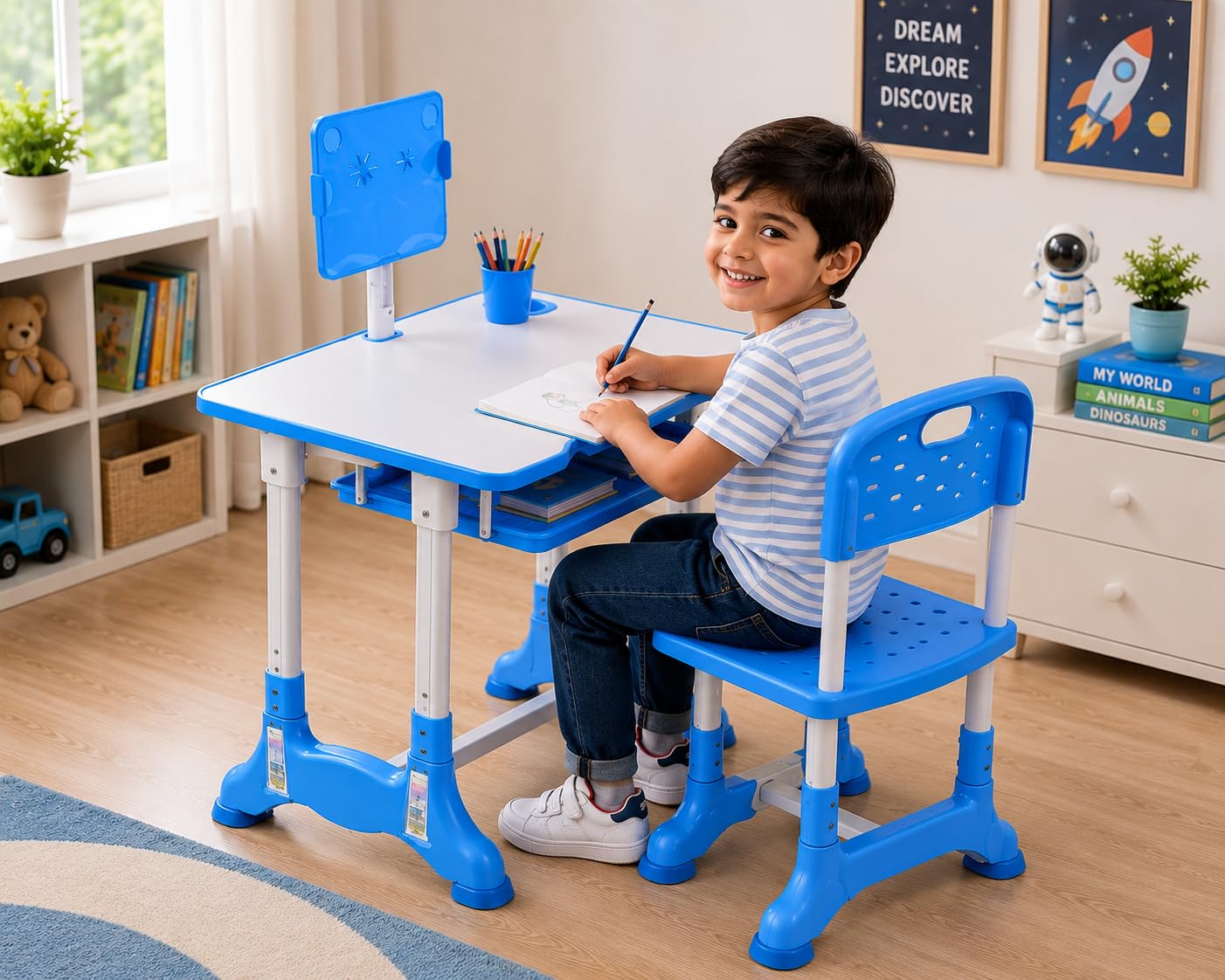

A study table for kids gives children a dedicated place for drawing, reading, homework and other learning activities. When comparing options on Amazon India, parents should check the desk’s height, tabletop size, stability, storage, chair compatibility and the amount of space available at home. The best choice is not necessarily the biggest or most expensive desk; it is one that fits the child and supports a comfortable, organised study routine.
Study Table for Kids on Amazon India: A Parent’s Guide to Size, Comfort and Features
Choosing a study table for kids can help families create a dedicated space for reading, drawing, homework and preschool activities. Parents shopping on Amazon India can compare compact desks, wooden tables, table-and-chair sets, adjustable models and designs with built-in storage.
However, a desk that looks attractive in a product photograph may not suit a child’s height or the available room. A tabletop that is too high, a chair that does not fit or a wobbly frame can make everyday activities less comfortable.
The practical approach is to consider the child’s age and measurements, the activities they will do at the table, and the space available at home. Parents should also check construction, stability, edges, assembly instructions and the manufacturer’s recommended age before buying.
What Is a Study Table for Kids?
A children’s study table is a desk designed for activities such as writing, reading, drawing, colouring, puzzles and schoolwork. Some products are simple tables, while others come with matching chairs, drawers, shelves or adjustable-height features.
A dedicated table can help keep books, pencils, worksheets and craft supplies in one place. It may also make it easier to establish a regular time and space for learning at home.
For preschool children, the table might mainly be used for colouring, picture books and hands-on activities. Older children may need more surface space for notebooks, textbooks, stationery and a school bag.
Parents can browse study tables for kids on Amazon India to compare styles, dimensions and current listings.
Types of Study Tables for Kids Available Online
The most suitable design depends on how the child will use the desk and how much space the family has.
1. Study Table and Chair Sets
A table-and-chair set provides two pieces designed to be used together. This can make shopping easier because parents can compare the intended seat height and tabletop height as a set.
Before purchasing, check both the table and chair dimensions. A matching set does not automatically guarantee a suitable fit for every child, especially if the child is particularly tall or short for their age.
Look for a stable chair and a table that allows the child to sit comfortably with their feet supported.
2. Wooden Study Tables
Wooden desks are available in different sizes and finishes. Depending on the design and materials, they may be suitable for a child’s bedroom, shared study area or playroom.
Check whether the product is made from solid wood, engineered wood or another material. These materials differ in weight, construction and maintenance needs, so do not assume that every product described as a wooden desk has the same durability.
Also inspect the listed dimensions, edge finish, weight capacity and assembly requirements.
3. Adjustable Study Tables
Some desks allow the tabletop height to be changed. This may help a desk accommodate a growing child, but the adjustment range matters more than the word “adjustable” in the product title.
Check the minimum and maximum heights, how the adjustment mechanism works and whether the desk remains stable at different settings. If a matching chair is included, check whether its height can also be adjusted.
An adjustable desk is useful only if it can be set to a comfortable working position for the child.
4. Study Tables with Storage
Desks with drawers, shelves or compartments can help organise books, stationery and activity materials.
For children who use worksheets, colouring books and craft supplies, storage can reduce clutter on the tabletop. However, storage should not make the desk difficult to use or create unnecessary tipping risks.
Check drawer dimensions, shelf capacity and whether the desk must be secured according to the manufacturer’s instructions. Keep heavy items in locations recommended by the manufacturer.
5. Compact Study Tables for Small Rooms
A compact desk may suit a bedroom or home where space is limited. Some designs provide a simple tabletop without drawers or large shelves.
Measure the available floor area before ordering. Include enough room for the chair to move and for the child to get in and out comfortably. Also check whether the desk will obstruct a door, cupboard or walking path.
A smaller desk can be practical for basic learning activities, but make sure it still has enough usable surface area for the child’s books and materials.
6. Preschool Activity Tables
Younger children may use a low table for colouring, building blocks, picture books, puzzles and other supervised activities. Some tables are designed for multiple children to use together.
For this age group, stability, easy-to-clean surfaces and suitable proportions are particularly important. Check age guidance and ensure that the chair and table are intended for the child’s size.
A preschool activity table does not need to resemble a traditional school desk. What matters is whether it supports the intended activities comfortably and safely.
How to Choose the Right Study Table Height
A desk should allow a child to sit comfortably without having to reach up to the tabletop or bend excessively over the work.
There is no single table height that suits every child of a given age. Body proportions, chair height and desk design all affect fit.
Check the table and chair together
When the child sits at the desk, look for these practical signs:
- The child can sit upright without having to stretch to reach the tabletop.
- The shoulders remain relaxed rather than raised toward the ears.
- The child can rest their forearms comfortably while drawing or writing.
- The chair supports a comfortable sitting position.
- The child’s feet are supported by the floor or a suitable footrest.
- The child can move in and out of the chair without difficulty.
These are general ergonomic checks, not a substitute for advice from a qualified professional when a child has specific seating or mobility needs.
Measure before you buy
Measure the child’s height and compare it with the product’s dimensions. If possible, check the table height, seat height and the distance between the seat and tabletop.
For an adjustable desk, read the full adjustment range. A desk may be described as adjustable but still be too tall or too short for a particular child.
Avoid relying only on a listing’s age label. A table advertised for preschoolers may not fit every preschool child comfortably.
A Study Table for Kids on Amazon India: Example Product to Compare

Amazon Brand – Jam & Honey Kids Functional Desk and Chair Set
An example of an adjustable table-and-chair set listed for children aged 3 and above.
The product listing describes a height-adjustable desk and chair set with a book-holder slot. Check the current Amazon listing to confirm the available colour, dimensions, materials, included parts, price and delivery options.
View the product on Amazon India
This is one example to compare, not a recommendation based on independent product testing. Check whether the measurements suit your child and whether the desk will fit your home before ordering.
You can also compare more study tables for kids on Amazon India to explore other sizes, styles and price ranges.
Safety Features Parents Should Not Overlook
A children’s study table should be stable and appropriately assembled. Safety is particularly important when the desk includes drawers, shelves, adjustable legs or other moving parts.
Check stability and construction
Before allowing the child to use the table, make sure it sits firmly on the floor and does not wobble under normal use. Follow the assembly instructions and tighten the fasteners as directed.
Inspect the edges, corners and joints. Avoid using a desk with cracked panels, sharp exposed hardware, damaged adjustment mechanisms or unstable legs.
Secure storage where appropriate
Drawers and shelves are useful, but children may pull on them or try to climb on furniture. Do not let children stand or climb on the table or use drawers as steps.
The U.S. Consumer Product Safety Commission advises families to secure furniture that could tip over and keep attractive items out of places that might encourage children to climb. Its guidance is particularly focused on heavier furniture and clothing-storage units, so it should not be interpreted as a claim that every small study table has the same risk.
For a tall desk with shelving or storage, follow the manufacturer’s instructions about wall anchoring and stability. Use the supplied restraint or appropriate hardware where required.
Keep the study area organised
Keep the floor around the desk clear of bags, loose cables and toys that could cause trips. Place frequently used books and stationery within comfortable reach so the child does not need to climb or stretch dangerously.
For younger children, supervise the use of drawers, small stationery items and accessories.
How to Organise a Child-Friendly Study Corner
Buying a table is only one part of creating a useful study space. A simple setup can make it easier for children to find their materials and move between activities.
Keep frequently used items within reach
Store pencils, crayons, books and worksheets in containers or drawers the child can reach safely. Keep sharp tools, small items that could be choking hazards and adult stationery supplies out of reach of younger children.
Provide suitable lighting
Place the desk where the child can see their work clearly. A well-lit room and a suitable task light can help reduce shadows on books and worksheets. Position lamps and electrical cords safely, away from the child’s movement and work area.
Match the setup to the child’s activities
For a preschooler, the tabletop may mainly need room for a colouring book, crayons and a small puzzle. A school-age child may need space for notebooks, textbooks and a pencil case.
Before buying, imagine what the child will use simultaneously. A desk that is too small may quickly become cluttered, while an oversized desk may occupy unnecessary room.
Build a manageable routine
A study table does not need to be used only for formal homework. Depending on the child’s age, it can be a place for reading picture books, completing puzzles, practising writing, colouring or doing supervised educational activities.
Short, age-appropriate activities and regular breaks may be more practical for young children than expecting them to sit for long periods.
What Officials and Organisations Say About Furniture Safety
The U.S. Consumer Product Safety Commission (CPSC) provides guidance on preventing injuries caused by unstable furniture. Its recommendations include securing furniture that could tip and avoiding arrangements that encourage children to climb. The agency’s furniture guidance is particularly relevant to heavier storage furniture and should be applied according to the type of product involved.
This is U.S. safety guidance, not certification of any particular study table sold in India. Parents should check the product’s manufacturer instructions, assembly requirements and any applicable Indian safety information.
No official announcement establishes one universally best study table for all children. Product suitability depends on the child’s measurements, intended activities, available space and the construction of the particular desk.
Why Choosing the Right Study Table Matters
A study table can provide a dedicated place for learning materials and creative activities. When the desk and chair fit the child, it is easier to arrange books and worksheets within reach and maintain a comfortable working position.
The purchase also involves practical considerations. A compact table may be better for a small bedroom, while a desk with storage may suit a child who uses many books and craft supplies. An adjustable model may offer more flexibility, provided its height range and stability are suitable.
Parents should avoid assuming that a more expensive or heavily advertised desk automatically offers better comfort or safety. Dimensions, construction, assembly and the child’s fit are more useful factors to evaluate.
What Happens Next After Buying a Study Table?
After the table arrives, follow these steps before the child begins using it:
- Inspect the package: Check for damaged panels, missing parts or visible defects.
- Assemble it correctly: Follow the supplied instructions and use the recommended fasteners.
- Check stability: Make sure the table and chair stand firmly and that any adjustment mechanism works as intended.
- Test the fit: Have the child sit at the table and check the chair height, tabletop reach and foot support.
- Arrange the study area: Provide suitable lighting and keep the floor clear.
- Explain safe use: Remind the child not to climb on the desk or stand on the chair.
- Recheck over time: Inspect the desk periodically, particularly after moving it or adjusting its height.
If the desk does not fit comfortably, check whether the chair or tabletop can be adjusted within the manufacturer’s limits. Do not modify the structure in a way that could compromise stability.
Frequently Asked Questions
1. Which study table is best for kids?
The best study table is one that fits the child’s height, provides enough space for their activities and remains stable during normal use. Compare table and chair dimensions, storage, construction and assembly requirements before choosing.
2. Where can I buy a study table for kids online in India?
You can browse study tables for kids on Amazon India. Compare current listings and verify the seller, dimensions, materials, warranty and return policy before placing an order.
3. Should I buy a study table with a chair?
A table-and-chair set can make it easier to compare the dimensions of both pieces together. However, check that the chair height and tabletop height suit your child. A bundled set is not automatically the right fit for every child.
4. Is an adjustable study table worth buying?
An adjustable desk may offer flexibility as a child grows, but only if its height range suits the child and the adjustment mechanism is stable and easy to use correctly. Compare the minimum and maximum heights before purchasing.
5. Which material is better for a kids study table: wood or metal?
Neither material is universally best. Compare the actual construction, stability, surface finish, weight, maintenance needs and manufacturer’s specifications. Some desks combine metal frames with wooden or engineered-wood panels.
6. What size study table should I buy for a preschool child?
Measure the child and compare the desk and chair dimensions with the manufacturer’s guidance. Check that the child can sit comfortably, reach the tabletop and keep their feet supported. Do not choose solely by the age printed on the listing.
7. Are study tables with storage useful for children?
They can help organise books, stationery and activity materials. Check that drawers and shelves are easy to access safely, the desk remains stable and the child cannot use the storage compartments as climbing steps.
8. How can I make a study table safer for a child?
Assemble the desk according to the instructions, check for sharp edges and loose hardware, and ensure it stands firmly. Secure taller furniture where the manufacturer recommends it, keep the floor clear and supervise young children.



