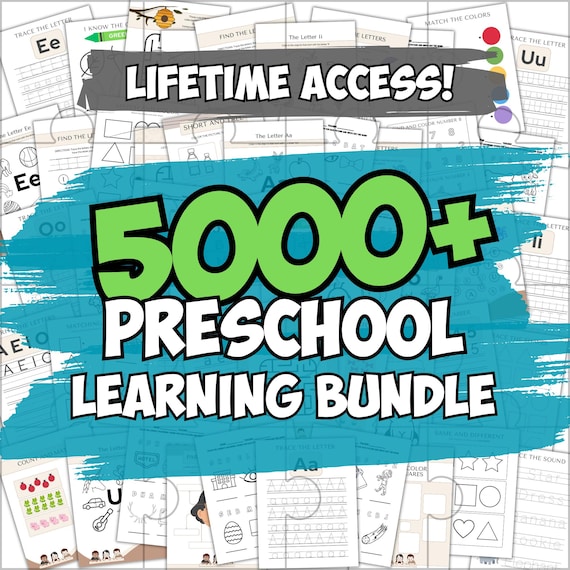

A Preschool Pre-K & Kindergarten Learning Bundle for ages 2–6 can give parents, homeschoolers, and teachers a convenient collection of printable activities for practicing early literacy, alphabet recognition, tracing, numbers, counting, fine-motor skills, coloring, matching, puzzles, and other foundational skills.
A strong early-learning resource should not be treated as a replacement for play or interaction. The Head Start Early Learning Outcomes Framework identifies approaches to learning, social-emotional development, language and literacy, mathematics, scientific reasoning, and physical development as important areas of preschool learning. NAEYC similarly describes developmentally appropriate practice as a strengths-based, play-based approach to joyful and engaged learning.
For children ages 2–6, the most effective approach is usually a mix of hands-on play, conversation, books, movement, creative activities, and short periods of structured printable practice.
Preschool Pre-K & Kindergarten Learning Bundle for Ages 2–6: A Complete Printable Learning Resource
Finding educational activities for young children can quickly become overwhelming. Parents may need alphabet tracing one day, counting practice the next, and a simple coloring or matching activity when a child needs something quiet and engaging.
Teachers and homeschool families face the same challenge: How can you provide enough variety without constantly creating new activities from scratch?
A Preschool Pre-K & Kindergarten Learning Bundle for ages 2–6 can help organize early learning into one convenient printable resource.
The Tiny Spark Kids learning bundle described here includes 5,000+ printable PDF pages covering a broad range of preschool and kindergarten-style activities, including alphabet tracing, early literacy, math practice, coloring, matching, puzzles, fine-motor activities, and other learning exercises.
The important point is not simply having thousands of pages.
The real value of a large learning bundle is being able to choose the right activity for a child’s age, current skill level, interests, and learning goal.
What Is a Preschool Pre-K & Kindergarten Learning Bundle?
A preschool and kindergarten learning bundle is a collection of printable educational activities designed to support children during the early-learning years.
For ages 2–6, activities may focus on:
- Alphabet recognition
- Letter tracing
- Pre-writing
- Numbers
- Counting
- Shapes
- Colors
- Matching
- Patterns
- Early literacy
- Vocabulary
- Fine-motor practice
- Coloring
- Puzzles
- Problem-solving
- Visual discrimination
- Basic classroom readiness
These areas overlap with major early-childhood learning domains. Head Start, for example, organizes preschool learning around areas including approaches to learning, social-emotional development, language and literacy, mathematics, scientific reasoning, and physical development.
That means a good printable collection should provide variety rather than focusing only on academic worksheets.
Why Use Printable Activities for Ages 2–6?
Printable activities are useful because they are easy to prepare and can be adapted to different situations.
A parent might use one page for a 10-minute activity at the kitchen table.
A homeschool family might use several pages as part of a weekly learning routine.
A teacher might place selected pages into a learning center, morning-work folder, homework folder, or early-finisher station.
However, worksheets work best as one component of a broader learning experience.
NAEYC emphasizes that developmentally appropriate practice is play-based and that young children benefit from active engagement, exploration, and inquiry.
What Can Children Learn With a Preschool Learning Bundle?
1. Alphabet and Letter Recognition
Alphabet activities can introduce children to uppercase and lowercase letters.
For younger learners, start with:
- Identifying letters
- Matching letters
- Finding a specific letter
- Recognizing letters in their names
As children become more comfortable, introduce tracing and early writing practice.
2. Alphabet Tracing and Pre-Writing
Alphabet tracing activities can give children opportunities to practice controlled pencil movements.
For a preschooler, the objective should not be perfect handwriting.
Instead, focus on:
- Holding and controlling a writing tool
- Following lines
- Recognizing letter shapes
- Practicing directional movements
- Building confidence
Parents can also supplement tracing with playdough letters, finger writing, drawing, and sensory writing.
3. Numbers and Early Math
A learning bundle can provide opportunities to practice:
- Number recognition
- Counting
- Number tracing
- Matching numbers to quantities
- Shapes
- Patterns
- Sorting
- Simple comparisons
Early mathematics does not have to mean sitting at a desk.
Children can count toys, sort socks, compare objects, build patterns with blocks, and identify shapes around the house.
NAEYC’s guidance on young children’s mathematics emphasizes building mathematical ideas through playful and intentional experiences.
4. Fine-Motor Development
Fine-motor activities involve controlled movements of the hands and fingers.
Printable activities can complement hands-on experiences such as:
- Drawing
- Coloring
- Tracing
- Cutting
- Pasting
- Playdough
- Building blocks
- Manipulating small learning materials
These activities can make printable practice more meaningful because children are using their hands in different ways.
5. Coloring and Creativity
Coloring pages are often considered entertainment, but they can also provide opportunities for children to practice visual attention, pencil control, color recognition, and creative expression.
Avoid turning coloring into a test.
Instead of saying, “The apple must be red,” try asking:
“What color would you like your apple to be?”
This leaves room for creativity.
Age-by-Age Guide: How to Use the Bundle
| Age | Good starting activities | Suggested approach |
|---|---|---|
| 2–3 years | Colors, shapes, matching, simple coloring, basic tracing | Short, playful activities with adult support |
| 3–4 years | Alphabet recognition, counting, patterns, tracing, puzzles | Combine printables with hands-on play |
| 4–5 years | Letter tracing, phonics preparation, numbers, shapes, early writing | Use structured practice alongside games and stories |
| 5–6 years | Alphabet, handwriting, counting, early math, literacy, problem-solving | Build short independent practice periods |
These are general activity suggestions, not rigid developmental rules. Children develop at different rates, and NAEYC’s approach specifically emphasizes considering both common developmental patterns and each child’s individual characteristics and experiences.
How Parents Can Use a 5,000+ Page Learning Bundle Without Overwhelming a Child
A huge collection can actually become difficult to use if parents try to print everything.
Instead, create a small weekly selection.
Try the 5-Activity Method
Choose:
1 literacy activity
Alphabet, letter recognition, tracing, or vocabulary.
1 math activity
Counting, numbers, shapes, or patterns.
1 fine-motor activity
Tracing, coloring, cutting, or drawing.
1 thinking activity
Matching, sorting, puzzles, or sequencing.
1 fun choice
Let your child choose the activity.
This gives children variety without making learning feel like a long school assignment.
A Simple 20-Minute Home Routine
For younger children, short sessions can be easier to manage.
5 minutes: Read a picture book or talk about the day’s topic.
5 minutes: Play a related learning game.
5 minutes: Complete one printable activity.
5 minutes: Draw, color, build, or play.
The routine can be adjusted according to the child’s age, attention span, interest, and energy level.
The goal is not to complete a certain number of pages.
The goal is meaningful learning.
How Homeschool Families Can Use the Bundle
A large printable collection can be particularly useful for homeschool planning because parents can select activities according to their child’s current learning goals.
For example:
Monday — Alphabet
- Letter recognition
- Alphabet tracing
- Letter-themed coloring
Tuesday — Numbers
- Number recognition
- Counting
- Number tracing
Wednesday — Shapes and Colors
- Shape matching
- Color sorting
- Shape coloring
Thursday — Literacy
- Picture vocabulary
- Beginning sounds
- Letter matching
Friday — Review and Play
- Puzzles
- Matching
- Coloring
- Games
- Child-choice activities
This approach avoids turning a large bundle into a rigid curriculum.
How Teachers Can Use Printable Learning Resources
Teachers can select individual pages rather than using an entire bundle at once.
Useful classroom applications include:
Morning work
Provide a short tracing, matching, or coloring activity.
Learning centers
Create stations for:
- Alphabet
- Numbers
- Shapes
- Fine motor
- Puzzles
- Coloring
Small-group instruction
Give children activities that match the skill being taught.
Early-finisher activities
Keep additional puzzles, matching pages, coloring activities, or brain games available.
Homework
Send home a small amount of age-appropriate practice when appropriate.
Differentiation
The same learning concept can be presented at different levels.
For example, one child might identify numbers while another child works on counting quantities or simple number relationships.
Why Play Should Still Be Part of the Routine
A printable workbook should never mean that every minute of a child’s day needs to be structured.
Play remains central to early learning.
NAEYC describes play as a major context for developing language, problem-solving, social skills, physical competence, self-regulation, and other foundational abilities.
Head Start likewise describes children as active learners and recommends combining intentional teaching with opportunities for exploration, discovery, problem-solving, and meaningful play.
A balanced routine might therefore look like:
Play → Read → Explore → Printable Practice → Create → Play
This gives children both structured and open-ended experiences.
How Tiny Spark Kids Can Fit Into an Early-Learning Routine
The Tiny Spark Kids Preschool Pre-K & Kindergarten Learning Bundle can be used as a flexible source of printable practice for families and educators looking for activities for children ages 2–6.
Rather than expecting children to complete pages simply because they are available, choose activities based on a specific purpose:
- Need letter practice? Choose alphabet tracing.
- Practicing numbers? Choose counting or number activities.
- Working on pencil control? Choose tracing and coloring.
- Looking for a quiet activity? Try matching or puzzles.
- Reviewing a concept? Select a few appropriate practice pages.
This makes the bundle a resource library, rather than something children need to complete from beginning to end.
Common Mistakes to Avoid
Mistake 1: Printing too much
More pages do not automatically mean better learning.
Better approach: Print only what matches your current goal.
Mistake 2: Expecting every child to work at the same level
Children develop differently.
Better approach: Adjust the activity difficulty and provide support when needed.
Mistake 3: Replacing play with worksheets
Worksheets are only one learning tool.
Better approach: Combine printables with play, books, movement, conversation, art, and hands-on exploration.
Mistake 4: Focusing only on correct answers
Young children also need opportunities to explain, explore, make choices, and try again.
Better approach: Ask questions such as, “How did you figure that out?” or “Can you show me another way?”
Final Takeaway
A Preschool Pre-K & Kindergarten Learning Bundle for ages 2–6 can make early-learning activities easier to organize by bringing alphabet tracing, literacy, math, coloring, matching, puzzles, and other printable practice into one resource.
But the number of pages is not the most important part.
The best use of a large learning bundle is intentional selection.
Choose activities that match the child’s age and current abilities, keep sessions manageable, and combine printable practice with play, reading, conversation, movement, creativity, and hands-on learning.
That approach is consistent with modern early-childhood guidance, which emphasizes developmentally appropriate, engaging, play-based learning rather than a one-size-fits-all approach.
Featured Image Concepts
- Bright learning table: Preschool children ages 2–6 using alphabet tracing, numbers, coloring pages, puzzles, and matching activities around a table.
- Printable bundle concept: A clean editorial layout showing stacks of preschool worksheets, alphabet tracing pages, numbers, shapes, coloring activities, and puzzle sheets.
- Parent-child homeschool scene: A parent helping a young child complete an alphabet tracing page while books, crayons, blocks, and other learning materials sit nearby.
Suggested Internal Linking Opportunities
Use these descriptive anchors if the corresponding Tiny Spark Kids pages exist:
- Preschool Worksheets
- Kindergarten Worksheets
- Alphabet Tracing Worksheets
- Math Worksheets for Preschoolers
- Fine-Motor Activities
- Printable Activity Books
- Educational Printable Bundle
- Preschool Coloring Pages
- Phonics Worksheets
- Kids Brain Games and Puzzles
FAQs
1. What is a preschool learning bundle?
A preschool learning bundle is a collection of educational activities designed to support young children’s learning in areas such as early literacy, mathematics, fine-motor development, recognition, problem-solving, and creativity.
2. What age is a preschool and kindergarten learning bundle for?
A bundle labeled for ages 2–6 can provide activities across toddler, preschool, pre-K, and kindergarten stages. However, parents should select individual activities based on the child’s abilities rather than assuming every page is appropriate for every age.
3. What should a 2-year-old learn from worksheets?
Two-year-olds generally benefit from very simple, short activities involving colors, shapes, matching, scribbling, basic tracing, and recognition. Worksheets should supplement—not replace—play, movement, conversation, books, and hands-on exploration.
4. Are alphabet tracing worksheets good for preschoolers?
Alphabet tracing can provide practice with letter recognition and controlled pencil movements. For younger children, it works best when combined with drawing, sensory activities, letter games, songs, and other hands-on experiences.
5. Can a printable bundle be used for homeschooling?
Yes. Parents can select individual pages to supplement a homeschool routine. A large bundle can provide variety, but it should be used flexibly rather than requiring children to complete every page.
6. What subjects should preschool worksheets cover?
Useful preschool resources may cover early literacy, alphabet recognition, pre-writing, numbers, counting, shapes, colors, patterns, vocabulary, fine-motor practice, problem-solving, and creative activities.
7. How many worksheets should a preschooler complete each day?
There is no universal number that every preschooler should complete. The appropriate amount depends on age, developmental level, interest, activity difficulty, and the child’s overall daily routine.
8. Can worksheets replace preschool?
No. Worksheets cannot provide everything children need from an early-learning environment. Children also benefit from relationships, conversation, physical activity, play, exploration, books, creative experiences, and hands-on learning. NAEYC specifically emphasizes play-based, engaged learning as part of developmentally appropriate practice.
9. How can teachers use a printable learning bundle?
Teachers can use selected pages for morning work, small groups, learning centers, independent practice, early-finisher activities, review, or differentiated instruction.
10. What skills can alphabet tracing practice?
Alphabet tracing can provide opportunities to practice recognizing letter forms, following lines, controlling a pencil or crayon, and developing early writing familiarity. It should be combined with other literacy experiences rather than used as the only form of literacy instruction.
11. Is a 5,000+ page bundle suitable for every child?
A large collection can offer variety, but not every page will be appropriate for every child. Parents and teachers should choose activities according to age, ability, interests, and learning goals.
12. What is the best way to use a large printable bundle?
Use it selectively. Choose a small number of activities for a specific learning goal, combine them with play and hands-on activities, and adjust the difficulty based on the child’s response. This makes a large resource more manageable and purposeful.