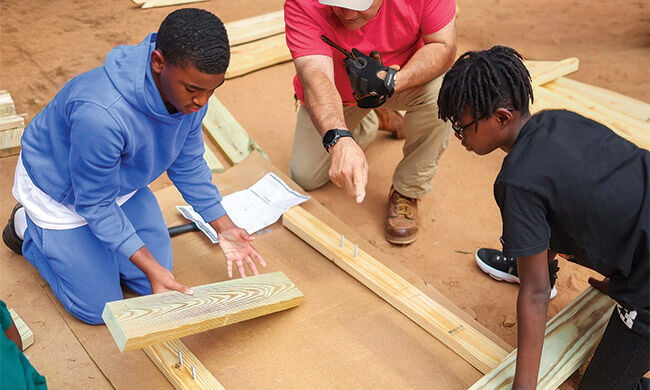

A new youth education initiative from The Home Depot is encouraging young people to discover skilled trades through hands-on projects, career exploration and practical skills. Launched September 17, 2026, Path to Pro Skills Explorers is designed for students ages 11–17 and introduces areas such as woodworking, plumbing, electrical work and painting. The initiative is part of a broader goal by The Home Depot and The Home Depot Foundation to provide 15 million introductions to skilled-trade careers by 2032.
Introduction
For many children, career exploration begins with a familiar question: “What do you want to be when you grow up?”
But answering that question can be difficult when young people have had little opportunity to see what different careers actually involve.
A new initiative from The Home Depot is taking a more practical approach. On September 17, 2026, The Home Depot and The Home Depot Foundation announced Path to Pro Skills Explorers, a free, facilitator-led program designed to help students ages 11–17 explore skilled trades through hands-on activities and career-focused lessons.
The program introduces students to areas including woodworking, plumbing, electrical concepts and painting. It also incorporates leadership, communication and other soft skills. The curriculum was developed with Scouting America and piloted with Boys & Girls Clubs of America.
The announcement comes as the U.S. construction industry continues to face concerns about the availability of skilled workers. The Home Depot’s announcement cites U.S. Bureau of Labor Statistics projections of 4.1 million construction skilled-trade job openings over the next decade and a National Association of Home Builders survey showing that only 6% of young adults currently express interest in construction trades.
The figures help explain why career exposure is increasingly being introduced before students reach the point of making postsecondary decisions.
What Happened?
On September 17, 2026, The Home Depot and The Home Depot Foundation announced a new commitment to create 15 million introductions to skilled-trade careers by 2032.
At the center of the announcement is Path to Pro Skills Explorers, a new educational program aimed at middle and high school students between ages 11 and 17.
Rather than asking students to decide immediately whether they want a career in construction, the program is designed to let them explore.
Students can work through facilitator-led activities and short educational content covering practical topics and different trade pathways.
The initiative is intended to be flexible enough for use in several settings, including schools, youth organizations, community programs and homes.
The Home Depot says the curriculum provides educators, parents and youth leaders with ready-to-use materials.
That approach is important because career awareness can develop through experience. A student who enjoys building something, solving a practical problem or working with tools may discover an interest that was previously invisible to them.
Key Details
The new program has several important features:
- Target age: Students ages 11–17.
- Cost: The Skills Explorers curriculum is offered free.
- Learning style: Facilitator-led activities combined with educational videos and hands-on projects.
- Trade areas: Includes woodworking, plumbing, electrical concepts, painting and other construction-related skills.
- Soft skills: The curriculum also addresses leadership, teamwork and communication.
- Partners: The program was developed with Scouting America and piloted with Boys & Girls Clubs of America.
- Access: Resources are designed for educators, parents, youth organizations and community programs.
- Long-term goal: The Home Depot and The Home Depot Foundation aim to provide 15 million introductions to skilled trades careers by 2032.
The program is not presented as professional trade certification for children.
Instead, its purpose is career exploration and early skills exposure.
That distinction matters. A teenager trying a basic woodworking activity is not the same as completing an apprenticeship or becoming qualified as an electrician or plumber.
5 Ways to Help Kids Discover Skilled Trades
The new program highlights a broader idea that parents, educators and mentors can use even without access to a formal trade curriculum.
1. Start Career Conversations Early
Career discussions do not have to begin with a decision about college, employment or a specific profession.
For younger students, the conversation can be much simpler.
Ask questions such as:
- What do you like making?
- Do you enjoy fixing things?
- Do you prefer working with your hands?
- Do you enjoy solving practical problems?
- What activities make you lose track of time?
- Would you rather build something or explain something?
The purpose is not to push a child toward a particular career.
Instead, early conversations can help children recognize their own interests.
The Home Depot says Skills Explorers is intended to reach young people at a point when career aspirations are beginning to develop.
That makes exploration more useful than simply presenting children with a list of jobs.
2. Turn Curiosity Into Hands-On Learning
One of the strongest features of skilled trades is that the work can be experienced physically.
Children can build, measure, assemble, repair, test and modify things.
That type of learning can complement classroom instruction.
Simple projects might include:
- Building a small wooden structure
- Learning how basic plumbing systems work
- Exploring simple electrical concepts under appropriate adult supervision
- Repairing a bicycle
- Painting and preparing surfaces
- Building models
- Learning how household tools are used safely
- Designing and constructing simple objects
The goal is not to turn every child into a future tradesperson.
It is to give children enough exposure to understand whether they enjoy this kind of problem-solving.
Path to Pro Skills Explorers follows this philosophy by combining career information with hands-on activities rather than relying solely on lectures.
3. Help Kids Recognize Skills They Already Have
A child may already demonstrate qualities that are useful in skilled trades without realizing it.
For example, a child who patiently assembles complicated building sets may be developing attention to detail.
A child who constantly takes things apart to understand how they work may have strong curiosity about mechanical systems.
Another child may enjoy organizing a project, explaining instructions to friends or finding solutions when something goes wrong.
These behaviors can be connected to broader skills such as:
- Problem-solving
- Patience
- Communication
- Planning
- Attention to detail
- Teamwork
- Adaptability
- Creativity
- Persistence
The important point is to recognize the skill rather than attach a career label too early.
Instead of saying, “You should become an electrician,” a parent might say, “You seem to enjoy figuring out how systems work.”
That leaves room for the child to continue exploring.
4. Show Children More Than One Definition of Career Success
Career exploration can sometimes become narrowly focused on a small number of professions.
Skilled trades offer another category of career pathways.
Construction-related fields include occupations involving electrical systems, plumbing, HVAC, carpentry, painting, masonry and many other specialized skills.
Some trades also offer routes into entrepreneurship and small-business ownership.
The National Association of Home Builders’ 2026 research found that among surveyed U.S. young adults ages 18–25, the share interested in construction-trade careers had increased from 3% in 2016 to 6% in 2026. The survey found that respondents identified good pay and the ability to obtain useful skills among the leading benefits of construction careers.
At the same time, the 6% figure shows that interest remains relatively limited.
That is one reason early exposure matters to organizations trying to expand the future workforce.
Children cannot seriously consider a career pathway they have never encountered.
5. Give Kids Access to Real Programs and Mentors
Interest becomes much more meaningful when children can meet people who actually work in the field.
Parents and educators can look for:
- School career and technical education programs
- Youth workshops
- Maker spaces
- Community construction programs
- Scouting activities
- Career fairs
- Job-shadowing opportunities for older students
- Apprenticeship information sessions
- Local trade organizations
- Hands-on youth programs
The Home Depot’s Skills Explorers curriculum is one example of an organized program designed specifically for this purpose.
The company says the materials can be used by educators, parents and youth organizations, including after-school and community programs.
A mentor can also make a difference because a job description only tells a student what a trade is called.
A conversation with a working professional can show what the work actually looks like day to day.
Background: Why Skilled Trades Are Receiving More Attention
The renewed focus on trade education is closely connected to workforce demand.
Construction requires workers with specialized practical skills, but the industry has faced persistent concerns about labor availability.
The Home Builders Institute reported that the construction industry had nearly 300,000 open jobs going into the end of 2025. The organization has linked the shortage of trained workers to delays, increased labor costs and challenges in expanding housing construction.
The National Association of Home Builders has also highlighted the workforce challenge.
In April 2026, NAHB said the U.S. housing industry would need approximately 2.2 million new skilled construction workers over the following three years to account for industry expansion, retirements and workers leaving the sector.
These figures come from industry organizations and should be understood in that context.
They do not mean that every construction occupation has identical demand or that every person entering a trade will automatically find a high-paying job.
However, they demonstrate why employers and workforce organizations are investing in the next generation.
Young People Are Showing Somewhat More Interest
The 2026 NAHB survey provides an important piece of context.
Among young adults ages 18–25, interest in construction trades doubled from 3% in 2016 to 6% in 2026.
That is a significant increase, but the overall share remains small.
The survey also found that 65% of respondents in 2026 knew the field in which they wanted to work, compared with 74% in 2016. NAHB interpreted the change as evidence that career certainty among young adults has declined while interest in construction has increased.
The results suggest that career exploration may be particularly valuable for students who have not yet settled on a professional direction.
Instead of treating uncertainty as a problem, schools and families can use it as an opportunity to expose students to more possibilities.
What Officials and Organizations Said
The Home Depot said the new initiative is designed to address the gap between demand for skilled workers and young people’s awareness of these careers.
Michael Rowe, executive vice president of Pro for The Home Depot, said the company’s experience supporting people entering the trades showed the need to begin career awareness earlier. The company says its new approach is intended to help young people understand the opportunities available in skilled trades.
Scouting America also participated in developing the program.
The organization’s president and CEO, Roger Krone, said the partnership builds on existing efforts to teach young people practical skills and introduces career preparation at an earlier stage.
Boys & Girls Clubs of America was involved in the pilot phase.
Its president and CEO, Jim Clark, said career exploration gives young people opportunities to build real-world skills and imagine different possibilities for their futures.
These are statements from organizations involved in the initiative, so they should be understood as their perspectives on the program rather than independent evaluations of its long-term effectiveness.
What Is Path to Pro Skills Explorers?
Path to Pro Skills Explorers is part of the broader Path to Pro initiative operated by The Home Depot.
The wider Path to Pro ecosystem includes information about skilled trades, free training and a network connecting tradespeople with potential employers.
The new Skills Explorers program is specifically aimed at younger students.
The Home Depot describes it as a free, facilitator-led program for ages 11–17, with short video lessons and hands-on activities.
The curriculum can be used in different environments.
For educators, materials include facilitation guides and videos that can be incorporated into STEM and career-exploration activities.
For parents, the program includes hands-on project guides.
For youth organizations, the materials are designed to work in group meetings, after-school programs and other community settings.
Why This Matters
The significance of the initiative extends beyond construction.
Children increasingly encounter careers through screens and social media, but many jobs are difficult to understand without seeing the work firsthand.
A child may know the word “electrician” without understanding what an electrician actually does.
They may know that a plumber repairs pipes but not understand how plumbing systems are designed.
They may hear about construction without realizing how many different specialized occupations are involved in building a home.
Hands-on exploration closes some of that gap.
It allows young people to ask practical questions and test their own interests.
There is also an educational benefit to connecting abstract concepts with physical activities.
Measurements can become more meaningful when a student needs them to build something.
Problem-solving can become more tangible when a project does not work the first time.
Teamwork becomes practical when students must complete a task together.
Skilled Trades Are Not a Replacement for Every Other Career Path
It is also important not to frame skilled trades as an alternative that every student should choose.
Children have different interests, abilities and goals.
Some may want to pursue medicine, science, technology, education, business, the arts or other fields.
The purpose of early skilled-trade exposure is to broaden the range of possibilities available to students.
A strong career education system can introduce students to multiple pathways rather than treating one route as universally appropriate.
That is particularly relevant because Path to Pro Skills Explorers is described as an exploration program, not a commitment to a particular occupation.
Safety Should Remain Central
Hands-on learning involving tools and construction materials also requires appropriate safety measures.
Children should not independently use potentially dangerous tools, electrical equipment or construction materials simply because an activity is labeled educational.
Age-appropriate equipment, adult supervision and clear instructions are essential.
The Skills Explorers program is designed with facilitators, educators, parents and youth leaders in mind, reinforcing the importance of guided learning.
For families creating their own projects, the safest approach is to choose activities appropriate for the child’s age and ability and follow the manufacturer’s safety instructions for any tools or equipment.
What Happens Next?
The immediate next step is the rollout and adoption of Path to Pro Skills Explorers among schools, youth organizations, educators and families.
The Home Depot and The Home Depot Foundation have set the much larger goal of 15 million introductions to skilled-trade careers by 2032.
The program is already available through Path to Pro’s online platform, where educators, parents and youth organizations can access information about the curriculum.
Whether the initiative ultimately changes the number of young people who enter construction trades will take years to measure.
The current program is primarily about exposure.
The longer-term test will be whether that exposure leads more students to pursue career and technical education, apprenticeships, certifications and employment in skilled occupations.
For now, the central message is straightforward: career discovery does not have to begin with a job application.
It can begin with curiosity.
A student who wants to know how something works can be given the opportunity to build it, test it and learn from the result.
That experience may not determine the child’s future, but it can expand the number of futures the child can imagine.
Frequently Asked Questions
1. What is the new skilled-trades program for kids?
Path to Pro Skills Explorers is a free, facilitator-led program launched by The Home Depot in September 2026 for students ages 11–17. It introduces young people to skilled-trade careers through videos, hands-on projects and career exploration.
2. What skilled trades can kids explore?
The program introduces areas including woodworking, plumbing, electrical concepts and painting. It also includes leadership, teamwork and other soft skills.
3. What age is Path to Pro Skills Explorers for?
The program is designed for young people ages 11 to 17, covering middle and high school students.
4. Is the Path to Pro youth program free?
Yes. The Home Depot describes Skills Explorers as a free educational curriculum for educators, parents and youth organizations.
5. Why should children learn about skilled trades early?
Early exposure can help children understand different career options before they make later educational and career decisions. It also allows them to discover whether they enjoy practical activities such as building, repairing, measuring and solving physical problems.
6. How many skilled-trade career introductions does The Home Depot plan to provide?
The Home Depot and The Home Depot Foundation announced a goal of providing 15 million introductions to skilled-trade careers by 2032. This is an organizational target, not a claim that 15 million people will necessarily enter the trades.
7. Why is there concern about the skilled-trades workforce?
Industry organizations have reported persistent shortages of construction workers. The Home Builders Institute reported nearly 300,000 open construction jobs going into the end of 2025, while NAHB said in 2026 that the industry would need about 2.2 million new skilled construction workers over three years to account for growth, retirements and departures.
8. Does learning about skilled trades mean a child should pursue a trade career?
No. Career exploration is intended to expand a student’s awareness of possibilities, not determine a career choice. Children can explore skilled trades alongside academic, technical, creative and other career pathways.