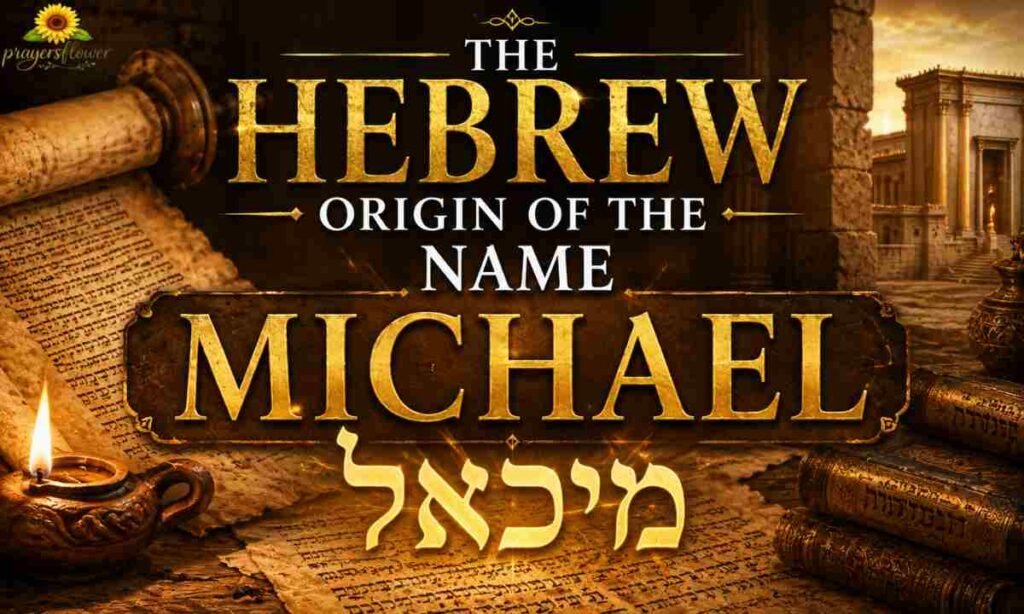

Michael is the Hebrew name that means “Who is like God?” Its original Hebrew spelling is מִיכָאֵל (Mikha’el). The name appears in the Bible and is associated with the archangel Michael, who is described in the Book of Daniel as a heavenly protector. The name’s meaning is generally understood as a rhetorical question emphasizing that no one is equal to God.
Introduction: Which Hebrew Name Means “Who Is Like God”?
The Hebrew name that means “Who is like God?” is Michael, a traditional name with deep roots in biblical history and religious culture. Written מִיכָאֵל in Hebrew, the name is commonly transliterated as Mikha’el and appears in Jewish and Christian biblical traditions.
Michael is more than a name with a religious association. Its meaning expresses a theological idea: no person or being can be compared with God in greatness or power. Although the name is widely used in English-speaking countries and many other parts of the world, its origins can be traced to the Hebrew language.
Parents searching for a meaningful baby name may be drawn to Michael because of its established history, recognizable pronunciation, and spiritual significance. It is also associated with the biblical archangel Michael, a figure connected with protection and heavenly authority.
What Is the Hebrew Name That Means “Who Is Like God”?
The name is Michael.
Its Hebrew form is מִיכָאֵל, commonly transliterated as Mikha’el. The traditional meaning is “Who is like God?” Some explanations express the same idea as “Who is equal to God?”
The name is phrased as a question, but it is not normally intended to request an answer. Instead, it makes a statement through a rhetorical question: no one is like God.
This distinction is important because the name does not mean that Michael himself is God. Rather, its traditional interpretation emphasizes God’s uniqueness.
Breaking Down the Name Michael
The name is commonly explained through three Hebrew elements:
- Mi (מִי): “Who?”
- Kə or kha-like comparative element: Associated with the idea of “like.”
- El (אֵל): “God” or a divine being, depending on context.
These elements are used in traditional explanations of the name’s meaning. Hebrew transliteration can vary because Hebrew sounds do not always correspond exactly to English letters.
The ending -el is found in several Hebrew names connected with God. Examples include Gabriel, which is traditionally understood as “God is my strength” or “strong man of God,” and Daniel, commonly interpreted as “God is my judge.”
What Is the Origin of the Name Michael?
Michael comes from Hebrew and has an ancient biblical history. Its Hebrew form, מִיכָאֵל, occurs in the Hebrew Bible, including in the Book of Numbers and the Book of Daniel.
The name was subsequently used in Greek and Latin forms and became established across numerous languages and cultures. Today, related forms include Michael in English, Mikael in several European languages, Mikhail in Russian, and Miguel in Spanish and Portuguese.
Although spelling and pronunciation differ across regions, these forms are generally associated with the same historical name.
Is Michael an Original Hebrew Name?
Yes. Michael has a Hebrew origin, even though it is now used internationally.
The name has been adopted into different languages through religious texts, cultural exchange, and centuries of naming traditions. Its widespread use does not change its Hebrew roots.
For people researching biblical baby names, Michael is a particularly recognizable example of a Hebrew name that has retained its traditional meaning across cultures.
What Does Michael Mean in the Bible?
Michael is a significant name in biblical literature. The Bible mentions several individuals named Michael, as well as a heavenly figure known as Michael.
The most prominent religious association is with the archangel Michael, who appears in the Book of Daniel. Daniel 10:13 refers to Michael as one of the chief princes, while Daniel 12:1 describes him as a great prince associated with the protection of Daniel’s people.
These passages have contributed to Michael’s traditional association with protection, spiritual strength, and heavenly leadership.
Michael in the Book of Daniel
The Book of Daniel is one of the principal biblical sources for understanding Michael’s religious significance.
In Daniel 10, Michael appears in a vision involving heavenly conflict. In Daniel 12:1, he is described in connection with a period of distress and the protection of the people.
These passages provide the foundation for many later Jewish and Christian interpretations of Michael as a powerful heavenly figure.
The name’s meaning and the figure’s biblical role are related, but they are not identical. The meaning “Who is like God?” comes from the Hebrew name itself, while descriptions of Michael’s role come from religious texts and their interpretation.
Is Michael an Archangel?
Michael is commonly known as the archangel Michael in Jewish and Christian traditions.
The exact way his role is described varies among religious traditions and texts. In Daniel, he is identified as a chief prince and protector. In Jude 1:9 in the New Testament, Michael is explicitly called an archangel.
In Revelation 12:7–9, Michael and his angels fight against the dragon and its angels. This passage has further shaped Christian depictions of Michael as a defender against evil.
It is useful to distinguish the biblical passages themselves from later artistic representations, devotional traditions, and popular beliefs about angels.
Why Is Michael’s Meaning Considered Powerful?
The name Michael is often associated with faith, humility, courage, and protection. These associations arise primarily from its religious meaning and the biblical figure connected with it.
The phrase “Who is like God?” places the emphasis on God’s uniqueness rather than on the human person carrying the name. For religious families, this can make Michael a meaningful choice that expresses reverence and devotion.
Its associations with protection and courage also reflect how Michael is portrayed in biblical passages and interpreted in later traditions. They are cultural and religious associations, not predictions about the personality or future of a person named Michael.
Common Symbolic Associations
People who choose Michael for its spiritual significance may connect the name with:
- Faith: A reminder of devotion to God.
- Humility: Recognition that no human being is equal to God.
- Protection: An association with Michael’s role in biblical passages.
- Courage: A quality linked with traditional depictions of the archangel.
- Tradition: A name used across generations and cultures.
These are interpretations of the name’s symbolism. A person’s actual character is shaped by many factors beyond the meaning of their name.
Is Michael a Good Baby Name?
Michael can be a meaningful choice for parents looking for a traditional boy’s name with Hebrew roots and a clear religious association.
It is familiar in many countries, has several established spelling variations, and is easy for many English speakers to recognize. Its biblical history may also appeal to families who want a name connected with Jewish or Christian tradition.
Whether it is the right choice depends on personal preference, family culture, pronunciation, and the surname it will accompany.
Reasons Parents May Choose Michael
A meaningful origin: The name has a clear and widely recognized traditional meaning.
Biblical history: Michael appears in important biblical passages.
International familiarity: The name and its related forms are used in numerous languages.
Nickname options: Common English nicknames include Mike and Mikey.
Established tradition: Michael has a long history of use rather than being a newly invented name.
Parents should also consider whether they prefer a traditional name, a less common alternative, or a spelling that reflects their family’s language and heritage.
How Do You Pronounce Michael in Hebrew?
The Hebrew form is מִיכָאֵל, often transliterated as Mikha’el.
Its pronunciation is not exactly the same in every language. In English, Michael is commonly pronounced “MY-kəl.” A pronunciation closer to the Hebrew form may be represented approximately as “mee-kha-EL,” although transliteration conventions and regional pronunciations vary.
The Hebrew consonant represented by kh can sound different from the English “k.” English speakers often use the familiar English pronunciation when saying the name.
If accurate Hebrew pronunciation is important to a family, listening to a native Hebrew speaker or a reliable Hebrew-language pronunciation resource is preferable to relying on an English spelling alone.
What Are the Variations of Michael?
Michael has developed several related forms as the name spread across languages.
| Name | Language or usage |
|---|---|
| Michael | English and several other languages |
| Mikael | Used in various European languages |
| Mikhail | Russian |
| Miguel | Spanish and Portuguese |
| Michel | French |
| Michał | Polish |
| Mihael | Used in some South Slavic languages |
| Mikha’el | A transliteration of the Hebrew form |
These forms are related through the history of the name, but spelling and pronunciation differ. Some may have their own local naming conventions and cultural associations.
Michael also has familiar English nicknames, including Mike, Mikey, and Mick. The appropriate form depends on personal preference and the language in which the name is used.
Are There Other Hebrew Names Connected With God?
Yes. Hebrew names often incorporate elements associated with God, including El. However, a name containing El does not automatically have the same meaning as Michael.
Examples include:
- Daniel: Traditionally interpreted as “God is my judge.”
- Gabriel: Traditionally associated with the meaning “God is my strength” or “strong man of God.”
- Raphael: Commonly interpreted as “God has healed.”
- Elijah: A Hebrew name associated with the statement “My God is Yahweh.”
- Nathaniel: Traditionally interpreted as “God has given.”
These meanings are based on conventional explanations of the names’ Hebrew origins. Individual names may have linguistic details that are more complex than a short English translation suggests.
If the exact meaning “Who is like God?” is the priority, Michael is the clearest and most widely recognized answer.
What Do Reliable Sources Say About the Name Michael?
Several reference sources identify Michael as a Hebrew name meaning “Who is like God?”
Reform Judaism’s baby-name reference lists Michael with the Hebrew spelling מִיכָאֵל and gives this traditional meaning. Behind the Name also traces the name to Hebrew and explains it as a rhetorical question implying that no one is like God.
Bible Gateway’s Encyclopedia of the Bible connects the name with the Hebrew form and the same meaning. Biblical passages, particularly Daniel 10:13 and Daniel 12:1, establish the historical religious context for Michael as a heavenly figure.
Together, these sources support the central facts about the name’s origin, meaning, and biblical association. They do not establish that a name determines a person’s character, abilities, or future.
Why the Name Michael Remains Meaningful
Michael has endured because it combines an established linguistic meaning with a substantial religious history. Its use across cultures shows how biblical names have travelled beyond their original language and become part of everyday naming traditions.
For some families, the most important feature is its meaning. For others, it is the association with the archangel Michael or the familiarity of the name across generations.
The name can therefore serve several purposes: it can reflect religious commitment, preserve a family tradition, or simply provide a recognizable name with an ancient origin.
Its meaning remains the same central idea: “Who is like God?” The phrase is traditionally understood as a declaration of God’s unmatched greatness, not a claim that the person named Michael possesses divine qualities.
Conclusion
The Hebrew name that means “Who is like God?” is Michael, written מִיכָאֵל in Hebrew. Its traditional meaning expresses the belief that no one is equal to God, and its biblical history is closely connected with the archangel Michael described in the Book of Daniel and other religious texts.
For parents searching for a Hebrew baby name with a spiritual meaning, Michael offers a combination of ancient origin, recognizable pronunciation, and lasting cultural significance. Its religious associations are well documented, while the choice of whether it suits a child remains a personal decision.
Frequently Asked Questions
1. What Hebrew name means “Who is like God”?
Michael is the Hebrew name that means “Who is like God?” Its original Hebrew spelling is מִיכָאֵל, commonly transliterated as Mikha’el.
2. What does the name Michael mean spiritually?
Spiritually, Michael is commonly understood as a reminder that no one is equal to God. Its meaning is associated with reverence, faith, and God’s uniqueness.
3. Is Michael a Hebrew or a Christian name?
Michael is of Hebrew origin and appears in Jewish biblical tradition. It is also important in Christianity, where Michael is commonly known as the archangel Michael.
4. Is Michael mentioned in the Bible?
Yes. Several individuals named Michael appear in the Bible. The best-known religious figure is the heavenly Michael described in Daniel 10:13 and Daniel 12:1. Michael is also called an archangel in Jude 1:9.
5. What is the Hebrew spelling of Michael?
The Hebrew spelling is מִיכָאֵל. It is often transliterated into English as Mikha’el, although transliteration styles can vary.
6. Is Michael a good name for a baby boy?
Michael may be a good choice for parents who want a traditional name with Hebrew roots, biblical significance, and an established history across cultures. The best name depends on a family’s preferences and traditions.
7. What are some names similar to Michael in meaning or origin?
Gabriel, Daniel, Raphael, Elijah, and Nathaniel are other names with Hebrew origins and traditional meanings connected with God. Their meanings differ from Michael’s exact meaning.
8. Does the name Michael mean that a person is like God?
No. The traditional meaning is a rhetorical question, “Who is like God?” It emphasizes God’s uniqueness rather than claiming that a person named Michael is equal to God.



