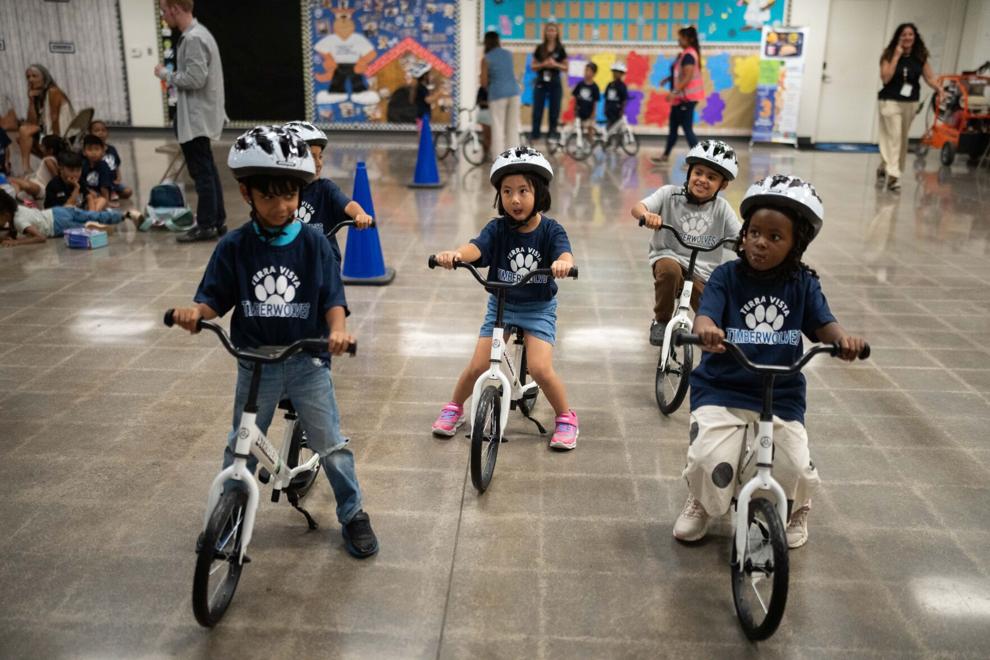

A kindergarten bike riding program is bringing bicycle lessons into U.S. elementary schools, allowing young children to learn balance, gliding and pedaling during physical education classes. The All Kids Bike program, operated by the Strider Education Foundation, is now active in more than 1,800 schools across all 50 states, according to the organization. Recent Associated Press reporting highlighted kindergarteners learning in a school gym at Terra Vista Elementary School in Rancho Cucamonga, California.
Introduction
Learning to ride a bicycle has traditionally been a childhood experience that happens in driveways, sidewalks, parks or quiet neighborhood streets. But in parts of the United States, that milestone is increasingly becoming part of the school day.
A kindergarten bike riding program is bringing bicycles into physical education classes, giving young children structured opportunities to learn balance, coordination and eventually independent cycling. Recent Associated Press reporting showed kindergarten students at Terra Vista Elementary School in Rancho Cucamonga, California, practicing on balance bikes inside their school gym in September 2026.
The development reflects a broader effort to make bicycle education available to children who may not otherwise have regular access to a bicycle, a safe place to practice or an adult who can teach them.
One of the largest programs behind this effort is All Kids Bike, the national campaign of the Strider Education Foundation. The organization says its kindergarten program is now active in more than 1,800 schools across all 50 states.
The idea is straightforward: rather than leaving the task of learning to ride entirely to families, schools can introduce the skill as part of physical education.
What Happened?
The recent attention around school-based bicycle lessons comes from an Associated Press report published September 15–16, 2026, describing kindergarten students participating in learn-to-ride instruction at Terra Vista Elementary School in Rancho Cucamonga, California.
Students were given helmets and balance bikes without pedals. Instead of immediately trying to pedal, children first learned to move the bikes with their feet and practice gliding.
The students followed a circular course marked by traffic cones while adults supervised and provided instructions.
This approach breaks bicycle riding into smaller skills rather than asking a young child to master everything at once.
The eight-lesson All Kids Bike curriculum progresses from becoming comfortable with the bicycle to balancing with both feet off the ground. Pedals are introduced later as children develop the necessary balance and control.
The approach is particularly suited to kindergarten physical education because the lessons can take place in a controlled environment.
Key Details
Several features distinguish the school-based approach from informal bicycle lessons at home.
- Balance comes first: Children begin with pedal-free balance bikes so they can concentrate on stability and movement.
- Lessons take place during PE: Bicycle skills can become part of structured physical education rather than an activity children have to learn outside school.
- Pedals come later: Once children become comfortable balancing and gliding, the program progresses toward conventional bicycle riding.
- Safety equipment is provided: Program packages include helmets and bicycle equipment.
- Teachers receive training: All Kids Bike provides teacher training and certification along with the curriculum.
- The program is designed for kindergarten: Its stated mission is to give children the opportunity to learn to ride during kindergarten PE.
- The program has broad reach: All Kids Bike says programs are active in more than 1,800 schools across all 50 states and teach more than 180,000 children to ride each year.
The program’s current package includes 24 Strider balance-to-pedal bicycles, pedal conversion kits, adjustable helmets, an instructor bicycle, storage racks, an eight-lesson curriculum and ongoing resource support.
Why Are Schools Teaching Kids to Ride Bikes?
The reasoning goes beyond simply teaching children a recreational activity.
Physical education in kindergarten is often focused on helping children understand movement, body control, sharing space and following instructions. Bicycle riding brings several of these skills together.
According to Seattle Public Schools, its bicycle and pedestrian safety education is designed to build bike-handling skills and confidence while teaching basic traffic safety and roadway rules.
Seattle’s official materials also describe cycling and walking as forms of everyday transportation and recreation, rather than activities limited to organized sports.
For young children, learning to ride involves coordinating several physical actions at once.
They have to control the bicycle, maintain balance, look where they are going, respond to instructions and manage their movement around other children.
That makes the activity useful as a movement-learning exercise as well as a practical life skill.
Background: How All Kids Bike Started
The school-based approach is not entirely new.
The Strider Education Foundation was formed in 2017, and the All Kids Bike initiative was launched the following year with a focus on bringing learn-to-ride instruction into kindergarten physical education. The organization’s earlier annual reports document its expansion from dozens of schools to hundreds.
By the end of 2021, the program reported operating in more than 443 schools across all 50 states. Its 2022–23 annual report documented continued expansion, with 380 programs delivered during 2022 alone and 824 schools reached cumulatively through that year.
More recent figures show a much larger footprint.
In July 2025, All Kids Bike reported programs in more than 1,600 schools. By October 2025, the organization said the number had grown to more than 1,700 schools. Its September 2026 materials now describe more than 1,800 active school programs.
That growth illustrates how bicycle education has gradually moved from individual community initiatives toward organized school-based programming.
How the Kindergarten Bike Riding Program Works
The program is structured around gradual skill development.
1. Getting Comfortable With the Bike
Children first become familiar with the bicycle and learn how to control it.
At this stage, there is no need to worry about pedaling.
2. Learning Balance
Balance bikes allow children to push themselves along using their feet.
As they gain confidence, they can lift their feet from the ground for increasingly longer periods.
3. Practicing Gliding
Gliding is an important transition between walking with a bicycle and riding independently.
Children learn that they can maintain movement while keeping the bicycle upright.
4. Introducing Pedals
The bikes used by All Kids Bike can be converted from balance bikes to pedal bikes.
That allows children to build on skills they have already developed instead of starting over with a completely different setup.
5. Building Toward Independent Riding
The ultimate goal is for children to control and ride the bicycle independently.
The process gives teachers opportunities to adjust instruction based on individual children’s progress.
What Teachers Are Seeing
Educators involved in the program say the benefits are not limited to physical coordination.
Drew Raney, a physical education teacher in California interviewed by the Associated Press, described moments when children begin gliding as particularly meaningful because they can see their confidence increase as students attempt something outside their comfort zones.
That observation is important because learning to ride a bicycle naturally involves trial and error.
A child may wobble, stop, try again and gradually gain control.
The school environment gives teachers an opportunity to turn those moments into structured learning rather than treating difficulty as failure.
The result can be a physical education lesson in persistence as well as movement.
What Officials and Organizations Said
The Strider Education Foundation, which operates All Kids Bike, says its mission is to teach every child in America how to ride a bicycle in kindergarten physical education.
The organization has expanded the program through donations, grants and partnerships.
For example, the Life Time Foundation announced a $90,000 grant in August 2025 to bring the program to 10 elementary schools. At the time, All Kids Bike reported programs in more than 1,700 schools.
Yamaha’s Outdoor Access Initiative has also provided funding. In July 2025, All Kids Bike announced a $108,000 Yamaha grant and said the organization had programs in more than 1,600 schools.
Honda announced another $100,000 contribution in October 2025 to support the program and traffic-safety education in elementary schools.
These partnerships matter because school bicycle programs require more than bicycles. Schools also need helmets, storage, teacher preparation, curriculum materials and ongoing support.
School Gyms Provide a Controlled Learning Space
One reason bicycles are appearing in school gyms is that indoor spaces offer a predictable environment for beginning riders.
A gym provides a flat surface without the traffic, uneven pavement and other variables children may encounter outdoors.
That does not eliminate the need for safety procedures. Children still need properly fitted helmets, supervision and instruction.
But it allows educators to focus initially on fundamental riding skills.
The recent Rancho Cucamonga example illustrates this model. Children practiced on a course marked with cones while adults supervised and directed the activity.
For schools with suitable outdoor space, bicycle instruction can also happen outside.
The concept is therefore broader than simply moving bicycles indoors. The larger development is the integration of learn-to-ride education into the school environment.
Bicycle Education Is Also About Access
Not every child grows up with the same opportunity to learn to ride a bicycle.
Some children may have a bicycle but lack a suitable place to practice. Others may live in neighborhoods where parents are uncomfortable letting young children ride outside.
Some families may also lack the time or confidence to teach the skill.
All Kids Bike was designed partly around this access issue. The organization says school-based instruction can give children the opportunity regardless of whether they have an adult or older sibling available to teach them.
That is one of the most significant aspects of the model.
Instead of bicycle riding being dependent entirely on family circumstances, schools can make the introductory experience available to an entire class.
The Program Can Extend Beyond Riding
Bicycle education can also become a starting point for broader safety instruction.
Seattle Public Schools, for example, combines bicycle education with pedestrian safety and traffic gardens. Its official program teaches basic traffic rules and safe behavior while helping students develop bicycle-handling skills.
Seattle’s traffic-garden approach creates controlled environments where students can practice navigating situations that resemble real-world streets.
This means school bicycle programs do not necessarily end when a child learns to balance and pedal.
They can eventually connect to questions such as:
- How should children behave around roads?
- What does a traffic sign mean?
- How should cyclists interact with pedestrians?
- Why is a helmet important?
- How can children ride safely in their communities?
These lessons make bicycle riding more relevant as a practical life skill.
Why This Matters for Early Childhood Education
The growing use of bicycle programs in schools reflects a broader question about what children should learn through physical education.
Traditional PE often includes running, jumping, throwing, catching and team sports.
Cycling adds another category: a practical movement skill that children can potentially use throughout their lives.
The physical challenge also develops progressively.
A child who cannot initially balance may learn to glide. A child who can glide may then learn to pedal. Later, that child can potentially use the bicycle for recreation, transportation or outdoor activity.
This gradual progression makes cycling particularly compatible with skill-based learning.
There is also an emotional component.
When a child successfully performs something that previously seemed difficult, the achievement can reinforce confidence and willingness to try unfamiliar activities. Teachers interviewed for the AP report specifically described this change in confidence as students began gliding.
That does not mean every child will respond identically, but it demonstrates why educators view the activity as more than simply learning to operate a bicycle.
A Growing Model, Not a Nationwide Requirement
It is important to clarify what the recent trend does and does not mean.
There is not a national U.S. requirement that all kindergarten students learn to ride bicycles at school.
Instead, programs such as All Kids Bike are being adopted by individual schools and districts, often with support from nonprofit organizations, donors and community partners.
The program’s reported reach is substantial, but it does not mean every U.S. kindergarten currently has bicycle instruction.
For example, Seattle Public Schools has incorporated bicycle and pedestrian education into its PE and safety programming, while individual schools elsewhere have joined All Kids Bike through donated equipment and funding.
What Happens Next?
All Kids Bike continues to expand through school applications, fundraising and partnerships.
The organization announced in August 2026 that new program applications submitted from October 1, 2026, would be subject to a $10,000 program price. Its program package includes equipment, teacher training, curriculum and support.
For schools, the next steps generally depend on funding, available physical education space, teacher preparation and local interest.
For children already participating, the immediate goal remains simple: progress from balance-bike practice to confident independent riding.
The longer-term question is whether more schools will treat bicycle riding as a standard component of physical education alongside other foundational movement skills.
Based on the program’s expansion over recent years, school-based bicycle education is no longer limited to a handful of experimental classrooms.
Why Parents May Pay Attention
For parents, the development offers another route for children to learn a skill that has traditionally been taught at home.
A school program does not replace family practice. Children still need opportunities to ride and develop their skills beyond structured lessons.
But schools can provide an important starting point.
Parents can reinforce what children learn by:
- Making sure the bicycle fits the child properly
- Ensuring the child wears a properly fitted helmet
- Practicing in an appropriate low-traffic environment
- Allowing children to progress at their own pace
- Teaching basic road and pedestrian safety
- Encouraging practice without turning mistakes into failure
The most useful lesson may be that bicycle riding is a skill that develops gradually.
Children do not have to master everything on their first attempt.
The Bigger Picture
The image of kindergarteners riding bicycles inside a school gym may look unusual to adults who learned on neighborhood streets.
But the underlying idea is relatively simple.
Schools already teach children many foundational skills that families once handled almost entirely at home. Bicycle education is increasingly being treated in the same way in some U.S. communities.
The growth of All Kids Bike shows that there is demand for structured programs that combine physical activity, balance training, safety education and equal access.
The September 2026 report from Rancho Cucamonga provides a clear example of what that looks like in practice: helmets, balance bikes, cones, teachers and young children gradually discovering that they can stay upright and move on two wheels.
For many children, the first successful glide may be more than a PE exercise.
It can be the beginning of a lifelong skill.
Frequently Asked Questions
1. What is the kindergarten bike riding program?
The kindergarten bike riding program discussed in the recent news is primarily the All Kids Bike Kindergarten PE Learn-to-Ride Program. It introduces bicycle skills through physical education, beginning with balance and gliding before progressing to pedaling.
2. Why are kindergartners learning to ride bikes at school?
Schools can provide structured instruction and equipment to children who might not otherwise have an opportunity to learn. Bicycle lessons can also develop balance, coordination, body awareness and confidence as part of physical education.
3. Do children start with regular pedal bicycles?
Not necessarily. The All Kids Bike curriculum begins with balance-bike skills. The program’s bikes can later be converted to pedal bicycles as students develop the required balance and control.
4. How many schools use All Kids Bike?
All Kids Bike said in September 2026 that its Kindergarten PE Learn-to-Ride Programs were active in more than 1,800 schools across all 50 states. The organization also reported that more than 180,000 children learn to ride through the programs each year.
5. Is bicycle riding mandatory for all U.S. kindergarten students?
No. There is no nationwide requirement for all kindergartners to learn bicycle riding at school. Individual schools and districts choose whether to participate in programs such as All Kids Bike.
6. What does the All Kids Bike curriculum include?
The program includes an eight-lesson curriculum, teacher training and certification, balance-to-pedal bicycles, pedal conversion kits, helmets, storage equipment and ongoing program support.
7. Can bicycle education include traffic safety?
Yes. Some school systems combine learn-to-ride instruction with bicycle and pedestrian safety. Seattle Public Schools, for example, teaches traffic rules and safe behavior alongside bicycle-handling skills.
8. Where was the recent kindergarten bike lesson highlighted?
The Associated Press recently reported on kindergarten students participating in a learn-to-ride program at Terra Vista Elementary School in Rancho Cucamonga, California, on September 2, 2026.