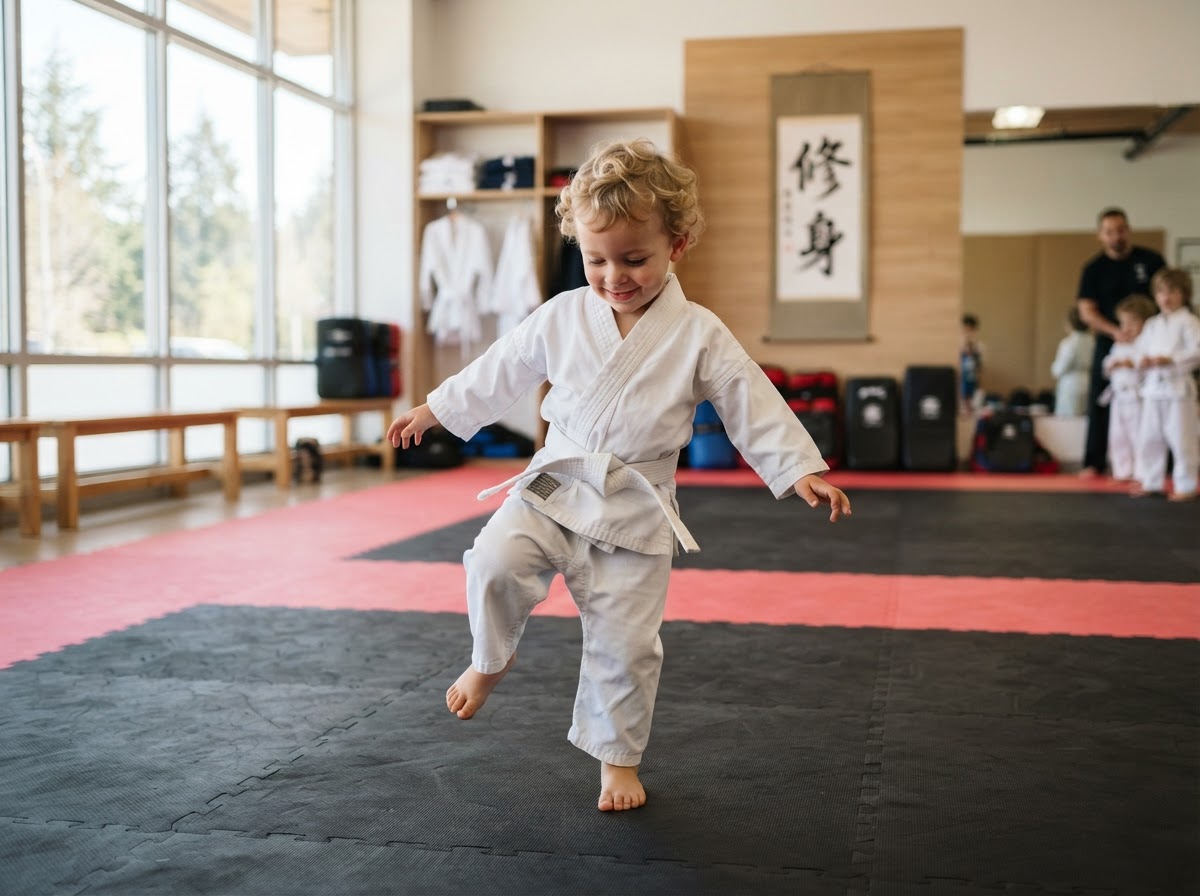

A typical 30-minute preschool karate class combines simple warm-up activities, basic karate movements, balance and coordination exercises, listening games, and a short cool-down. The instructor usually keeps activities brief, playful and age-appropriate so children can practise following directions and controlling their movements without being expected to perform advanced techniques. There is no single official 30-minute format: each school creates its own lesson plan.
Introduction: A Preschool Karate Class Is More Like Guided Play Than a Traditional Martial Arts Workout
A 30-minute preschool karate class is usually designed around short, simple activities that introduce young children to basic martial arts movements while keeping them active and engaged. For children around ages 3–5, a session may include a playful warm-up, basic punches and kicks performed in the air, balance exercises, listening games, and a brief closing routine.
Unlike classes for older children, preschool karate should not be focused on fighting, hard physical conditioning, or competitive sparring. The main purpose is to introduce movement skills and simple karate concepts in a safe, encouraging environment.
There is no universal lesson plan followed by every karate school. Some programs use obstacle courses and animal-themed games, while others spend more time practising basic stances, blocks, and punches. However, a well-organized beginner class generally balances movement, instruction, repetition, and rest.
For parents considering karate for a young child, understanding what happens during those 30 minutes can make it easier to judge whether a class is suitable.
What Happens in a 30-Minute Preschool Karate Class?
A typical session can be divided into five parts. The timings below are an example of how an instructor might organize a short class, not an official karate standard.
Example 30-minute preschool karate schedule
- 0–5 minutes: Welcome and warm-upChildren gather, practise a simple greeting, and begin moving with easy games and stretches.
- 5–13 minutes: Basic karate movementsThe instructor introduces simple stances, hand movements, and controlled kicks.
- 13–21 minutes: Movement and coordination gamesChildren practise balance, stepping, jumping, and following movement instructions.
- 21–27 minutes: Skill practice and listening activitiesThe group repeats a few movements, responds to simple commands, and practises classroom routines.
- 27–30 minutes: Cool-down and goodbyeThe class slows down, reviews a skill, and finishes with a closing routine.
Illustrative schedule only. Individual schools may use different activities and timings.
1. Welcome, Greeting and Warm-Up (0–5 Minutes)
The first few minutes help children settle into the class and understand what is expected of them.
The instructor may ask children to stand on a marked spot, sit in a circle, or line up with the rest of the group. They might begin with a simple greeting, such as bowing, which is used in many traditional karate settings to show respect.
The warm-up then introduces gentle movement.
Activities may include:
- Walking or marching around the training area.
- Light jogging, if appropriate for the group.
- Reaching both arms up and down.
- Gentle side-to-side movements.
- Hopping or jumping in place.
- Following the instructor’s movements.
Some instructors turn warm-ups into games. For example, children might pretend to walk like a bear, hop like a frog, or move slowly like a turtle.
These activities are not simply entertainment. They help young children become comfortable with the training space and prepare their bodies for movement.
What children practise: Listening to instructions, moving safely around others, warming up, and becoming familiar with the class routine.
2. Learning Basic Karate Movements (5–13 Minutes)
After the warm-up, the instructor may introduce one or two basic karate movements.
At preschool age, the aim is to help children understand simple body positions and controlled movement. They are not expected to master complicated techniques.
Basic karate stances
A stance is a body position used in karate. Beginners may practise standing with their feet apart, bending their knees slightly, and keeping their bodies balanced.
The instructor might demonstrate a basic ready position and ask children to copy it.
Simple punches in the air
Children may learn how to make a fist safely and extend one arm forward in a controlled movement.
The instructor can demonstrate slowly and ask the children to copy the action. Punches should be directed into the air, not toward another child.
Beginner blocks
A block is a movement used in karate to practise defensive positioning. Preschoolers may copy a simple arm movement without needing to understand advanced defensive techniques.
Basic front kicks
Children might practise lifting one knee and gently extending a foot forward before returning it to the floor.
The movement should be controlled. In a suitable preschool class, children should not be encouraged to kick one another.
What children practise: Body awareness, balance, coordination, remembering movement sequences, and controlling their actions.
3. Balance, Coordination and Movement Games (13–21 Minutes)
Young children often learn physical skills more comfortably when instruction is combined with play.
This part of a preschool karate class may involve simple games that help children practise the movements introduced earlier.
Possible activities include:
- Balance challenge: Stand on one foot briefly with the instructor’s guidance.
- Jumping game: Jump forward between floor markers.
- Movement pathway: Walk, step, or hop around cones.
- Follow the leader: Copy the instructor’s movements.
- Stop-and-go game: Move when instructed and stop when the instructor gives a signal.
- Target practice: Direct a gentle movement toward a suitable padded target under close supervision, if the school uses this activity.
These games can help children practise gross motor skills, which involve larger movements of the arms, legs, and body.
They also provide opportunities to practise spatial awareness. Children learn to notice where other people are standing and how to move without bumping into them.
A good instructor adapts activities to the children’s abilities. A child who cannot balance on one foot for long does not need to be pressured to perform like an older student.
4. Skill Repetition and Listening Games (21–27 Minutes)
The next few minutes may focus on repeating the movements taught earlier.
Repetition helps children become familiar with a skill. However, preschoolers generally benefit from short instructions and changes in activity rather than long technical explanations.
The instructor might ask the group to:
- Stand in a ready position.
- Copy one simple punch in the air.
- Return to the ready position.
- Practise a gentle front-kick movement.
- Stop when the instructor gives a signal.
Some classes include listening games using simple words such as “ready,” “go,” and “stop.”
For example, children may move around a designated area when the instructor says “go” and freeze when the instructor says “stop.”
The purpose is to practise responding to instructions while maintaining control of their movements.
This part of the class may also introduce basic karate etiquette, such as waiting for a turn, respecting personal space, and listening while someone else is speaking.
What children practise: Following directions, taking turns, remembering simple sequences, and controlling their movements.
5. Cool-Down, Review and Goodbye (27–30 Minutes)
The final few minutes help children transition out of the activity.
The instructor may slow the pace with gentle movements, simple breathing, or a short stretch. The group might then review one movement from the lesson.
For example, the instructor could ask:
- Which stance did we practise?
- Can everyone show the ready position?
- What should we do when the instructor says stop?
The instructor may finish with a traditional bow or another class closing routine.
Some schools give children stickers, attendance marks, or other small rewards. These are optional teaching methods, not requirements of karate.
A positive ending helps children leave the class feeling comfortable and gives parents an opportunity to hear what the group practised.
What Do Preschoolers Actually Learn in a Karate Class?
A 30-minute class is an introduction to movement and martial arts routines. Children should not be expected to become skilled karate practitioners after a few sessions.
The skills they may begin practising include:
| Skill area | What a child may practise |
|---|---|
| Balance | Standing steadily and shifting body weight |
| Coordination | Moving arms and legs in a controlled way |
| Listening | Responding to short instructions |
| Memory | Remembering simple movement sequences |
| Body awareness | Understanding where their body is in space |
| Social interaction | Taking turns and sharing training space |
| Self-control | Starting and stopping movements when asked |
| Confidence | Trying new activities and practising unfamiliar movements |
These are possible learning opportunities, not guaranteed outcomes. Children’s progress depends on their age, development, attendance, interest, and the quality of instruction.
How Is Preschool Karate Different From Karate for Older Children?
A preschool karate class should look noticeably different from a class designed for school-aged children or teenagers.
The biggest difference is the teaching approach.
Older students may spend more time practising formal techniques, combinations, kata, physical conditioning, and structured partner drills. Preschoolers usually need simpler demonstrations, more movement games, shorter practice periods, and frequent encouragement.
| Class feature | Preschool karate | Older children’s karate |
|---|---|---|
| Instructions | Short and simple | More detailed |
| Activities | Games and basic movements | More structured technique practice |
| Training time | Often short sessions | May involve longer sessions |
| Techniques | Basic, controlled movements | Increasingly complex techniques |
| Partner work | Limited or carefully adapted | May include supervised partner drills |
| Sparring | Generally not appropriate as a routine beginner activity | Depends on age, readiness, rules, and supervision |
| Main focus | Movement, participation, and basic skills | Technical development and progression |
A school should not simply place a three-year-old in a class designed for older children and expect the child to keep up.
Is a 30-Minute Karate Class Enough for a Preschooler?
A 30-minute class can be a practical introduction to karate for a young child. It provides a short period of structured movement without requiring the child to participate in a long training session.
However, one class should not be treated as a child’s entire daily exercise routine.
The U.S. Centers for Disease Control and Prevention (CDC) says children ages 3–5 should be physically active throughout the day to support growth and development. It encourages caregivers to provide opportunities for enjoyable movement, including activities such as jumping and riding a tricycle.
That means karate can be one part of a preschooler’s activity routine, alongside outdoor play, walking, dancing, playground activities, and other age-appropriate movement.
Parents should also consider the child’s response. If a child becomes tired, overwhelmed, or uncomfortable, the instructor should be willing to adapt the activity.
Is Preschool Karate Safe for Children Ages 3–5?
Safety depends on the instructor, teaching methods, environment, supervision, and type of activity.
A preschool beginner class should emphasize controlled, non-contact movements rather than fighting. Children should have enough space to practise without accidentally hitting or kicking one another.
The American Academy of Pediatrics has published educational guidance about martial arts and injury prevention. Its materials distinguish between non-contact forms and drills, which generally carry a lower injury risk, and contact activities such as sparring, which carry greater risks.
One important research detail: the AAP’s 2016 clinical report on youth participation and martial arts was retired in March 2025. It can still be consulted as a historical clinical report, but should not be described as a current active AAP policy.
Safety features parents should look for
- A clean training area with suitable flooring.
- Clearly defined spaces for children to practise.
- An instructor experienced in teaching young children.
- Close supervision throughout the session.
- Simple activities that match the children’s developmental abilities.
- No pressure to hit or kick other children.
- No forced participation in movements a child cannot safely perform.
- Clear rules for stopping, taking turns, and respecting personal space.
Parents should ask the school how it handles injuries, emergencies, supervision, and children who need a break.
What Should Parents Bring to a Preschool Karate Class?
Most beginner classes do not require families to purchase a complete uniform immediately. Requirements differ by school, so parents should confirm what is needed before buying equipment.
Common items may include:
- Comfortable clothing that allows free movement.
- A karate uniform, if the school requires one.
- A water bottle.
- A small towel, if needed.
- Any school-approved protective equipment required for a particular activity.
Children should avoid jewellery and accessories that could catch or cause injury during movement.
Parents should also check whether the school expects children to train barefoot and whether its floor is suitable for that arrangement.
What Should Parents Watch During a Trial Karate Class?
A trial class is a useful opportunity to see how the instructor interacts with preschoolers.
Rather than judging the school only by its belts, uniforms, trophies, or equipment, watch how the children are taught.
Signs of a well-organized class
- The instructor gives short, understandable instructions.
- Activities change before children lose interest.
- Children have enough space to move.
- The instructor notices when a child needs help or a break.
- Beginners are not compared unfairly with more experienced students.
- The class includes basic safety rules.
- Children are encouraged without being frightened or embarrassed.
Warning signs
Parents should be cautious if they see:
- Preschoolers being pushed into physical contact or sparring.
- Children kicking or punching one another without suitable controls.
- An instructor shouting aggressively or humiliating children.
- Long periods of waiting with little supervision.
- Activities that appear too difficult for the age group.
- A crowded training area with no clear movement boundaries.
- Pressure to sign an expensive long-term contract before a trial.
A good preschool program should make safety and age-appropriate teaching more important than quick belt advancement.
What If a Child Does Not Follow Instructions or Joins In Slowly?
It is normal for a young child to need time to become comfortable in a new environment.
Some children may copy every movement immediately. Others may prefer to watch the instructor before participating. A child might also become distracted, need a short break, or feel uncomfortable being separated from a parent.
This does not automatically mean karate is unsuitable.
Parents can ask whether the instructor allows beginners to observe briefly, participate gradually, or take a break when needed. The school should explain how it supports children who are shy, energetic, or still learning to follow group instructions.
The aim should be gradual participation, not forcing a child to perform.
How Often Should a Preschooler Attend Karate Classes?
There is no single attendance schedule that is right for every child.
Some families begin with one short class per week and observe how the child responds. Others may choose a different schedule based on the school’s program, the child’s interest, and the family’s routine.
Before increasing attendance, consider:
- Whether the child enjoys going to class.
- Whether the child has enough time for free play and rest.
- Whether the sessions are appropriate for the child’s age.
- Whether the child seems unusually tired or distressed after training.
- Whether the instructor recommends additional sessions for a clear developmental reason.
Karate should complement a varied routine of physical activity. It should not replace outdoor play or become a source of unnecessary pressure.
What Happens After the First Few Preschool Karate Classes?
During the first few sessions, children are mainly becoming familiar with the instructor, training space, class rules, and basic movements.
Over time, a child may become more comfortable with:
- Entering the training area.
- Standing in a ready position.
- Copying a basic punch or kick in the air.
- Moving around cones or floor markers.
- Stopping when asked.
- Waiting for a turn.
- Participating in a short group routine.
Progress will vary. Some children may learn the class routine quickly, while others may need several weeks to feel comfortable.
A belt or certificate should not be the only measure of progress. For a preschool beginner, becoming comfortable with movement, practising safely, and enjoying the class are meaningful early milestones.
Why a Good 30-Minute Class Should Focus on Enjoyment and Safety
A preschool karate class is not simply a shorter version of adult martial arts training. It needs a different approach that recognizes how young children learn and move.
A suitable program combines basic karate movements with playful physical activities, simple instructions, repetition, and positive encouragement. It gives children opportunities to practise coordination, balance, listening, and self-control without expecting advanced technical performance.
For parents, the most useful question is not whether a school teaches the most complicated techniques. It is whether the instructor can make a short class safe, engaging, understandable, and appropriate for children ages 3–5.
A child who leaves class feeling comfortable and interested in returning is likely to have had a more positive introduction than one who is pushed through activities that are too demanding.
Frequently Asked Questions
1. What do children do in a 30-minute preschool karate class?
Children may participate in warm-up games, basic stances, simple punches and kicks in the air, balance exercises, movement games, listening activities, and a short cool-down. The exact activities depend on the karate school.
2. Is 30 minutes of karate enough for a 3-year-old?
Thirty minutes can be a reasonable introductory class for a three-year-old if the activities are age-appropriate and the child is comfortable participating. It is not intended to replace the child’s other daily physical activities and play.
3. Do preschool children learn to fight in karate?
A suitable beginner preschool class should focus on basic movements, coordination, balance, listening, and self-control—not fighting. Contact activities and sparring should not be treated as necessary parts of a young beginner’s class.
4. What karate moves can a 4-year-old learn?
Depending on the program and the child’s development, a four-year-old may practise a ready position, simple stances, controlled punches in the air, beginner blocks, and basic front-kick movements. The instructor should demonstrate each movement and adapt it to the child’s ability.
5. Do children need a karate uniform for their first class?
Not always. Some schools allow beginners to attend a trial class in comfortable clothing. Other schools have specific uniform requirements. Parents should check with the instructor before purchasing a uniform.
6. How many children should be in a preschool karate class?
There is no single class-size limit that applies to every karate school. What matters is whether the instructor can supervise every child, provide individual attention, and maintain safe spacing. Ask how the school manages its group size and supervision.
7. Should preschoolers practise karate sparring?
Preschool beginners generally do not need sparring as part of their introductory training. Parents should look for a program that emphasizes non-contact techniques, controlled movements, and safety. Any contact activity requires careful consideration of age, readiness, rules, and supervision.
8. What should parents look for in a preschool karate instructor?
Look for an instructor with experience teaching young children, appropriate martial arts training, clear safety procedures, and a patient teaching style. The instructor should understand that preschoolers need short instructions, demonstrations, encouragement, and activities suited to their developmental abilities.