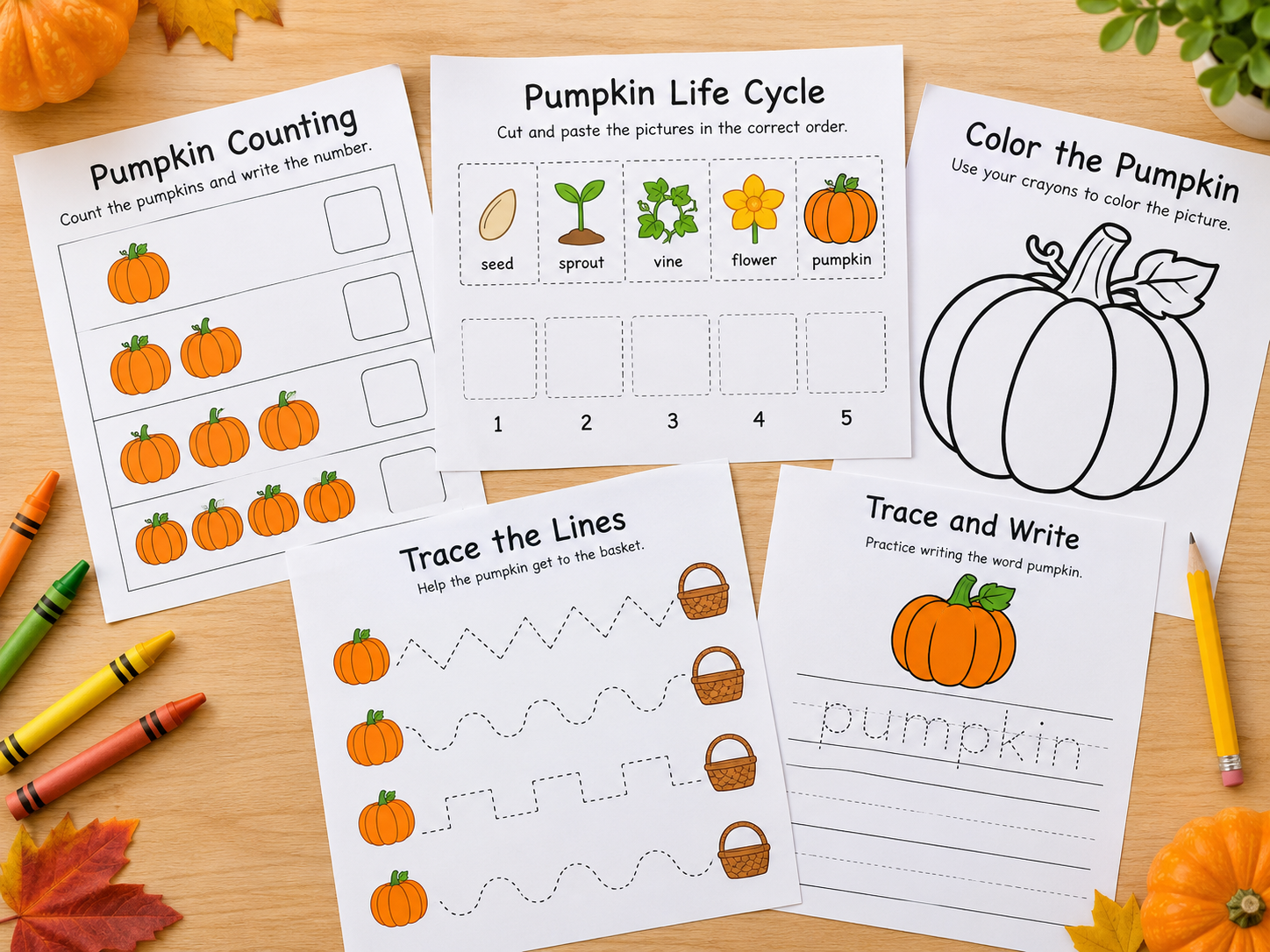

Pumpkin worksheets for preschool are printable activities that help young children practice early math, handwriting, coloring, letter recognition, and basic science through a familiar autumn theme. Popular options include pumpkin counting pages, tracing activities, coloring sheets, and worksheets showing how a pumpkin grows from a seed into a mature plant. Parents and teachers can use these activities at home, in preschool classrooms, or during fall-themed learning centers.
Introduction: Make Preschool Learning Fun With Pumpkin Worksheets
Pumpkin worksheets preschool activities give young children an engaging way to explore early learning concepts through an autumn favorite. These printables can combine simple counting, tracing, coloring, letter recognition, and nature-based learning on pages designed for little learners.
Pumpkins are especially useful for seasonal lessons because children can see them in gardens, grocery stores, farms, and autumn decorations. Teachers can connect a worksheet to a real pumpkin, a picture book, a counting game, or a conversation about how plants grow. Families can use the same activities at home without needing an elaborate lesson plan.
The National Association for the Education of Young Children (NAEYC) has highlighted pumpkin exploration as an opportunity for preschool children to investigate textures, observe seeds, count objects, and learn about plant growth. These experiences can bring science, mathematics, language, and creative play together.
Example image: A collection of pumpkin-themed preschool worksheets.
The most useful pumpkin worksheets are not necessarily the ones with the most activities. They are the ones that match a child’s current skills, offer clear instructions, and leave room for hands-on exploration.
What Are Pumpkin Worksheets for Preschool?
Pumpkin worksheets are printable learning pages that use pumpkin pictures, vocabulary, or seasonal themes to introduce skills appropriate for young children. They may be black-and-white pages for coloring, activity sheets with pictures to count, or simple diagrams showing how a pumpkin plant develops.
Some are designed for children who are just learning to hold a crayon. Others introduce early writing, number recognition, patterns, or simple science vocabulary.
Common types include:
- Pumpkin counting worksheets: Count pictured pumpkins and identify the matching number.
- Pumpkin tracing worksheets: Follow dotted lines, curves, or the outline of a pumpkin.
- Pumpkin coloring pages: Color pumpkins, leaves, stems, and autumn scenes.
- Pumpkin alphabet worksheets: Recognize letters or connect the letter P with the word pumpkin.
- Pumpkin life-cycle worksheets: Arrange pictures showing stages of plant growth.
- Pumpkin shape worksheets: Notice circles, ovals, and other shapes in pumpkin illustrations.
- Pumpkin matching activities: Match pictures, shadows, colors, or related objects.
- Pumpkin pattern worksheets: Complete simple repeating patterns using pumpkin pictures.
A printable can focus on one skill or combine several. For preschoolers, a clear page with one main learning goal is often easier to use than a crowded worksheet with many unrelated tasks.
Key Details: What Children Can Learn From Pumpkin Worksheets
Pumpkin-themed activities can support several early learning areas. The worksheet itself is only one part of the experience; talking, observing, moving, and experimenting can make the lesson more meaningful.

1. Pumpkin Counting Worksheets
Children count pumpkin pictures and connect each group to a number. Begin with small quantities, point to each pumpkin as you count, and ask the child to choose the matching number. Use real toy pumpkins or paper cutouts if pictures alone are difficult.

2. Pumpkin Tracing Worksheets
Tracing activities give children a chance to practice controlled hand movements. They may trace a pumpkin outline, follow wavy lines, or trace the word pumpkin. Start with large paths and let children use crayons or washable markers if those tools are more comfortable.

3. Pumpkin Coloring Pages
Large pumpkin pictures invite children to explore colors and make their own design choices. Ask open-ended questions such as, “What colors do you want to use?” rather than requiring every pumpkin to look the same.

4. Pumpkin Life-Cycle Worksheets
These activities introduce how a pumpkin plant grows. Children can place pictures in sequence, discuss what comes first, and learn words such as seed, sprout, vine, flower, and pumpkin.

5. Pumpkin Alphabet Worksheets
Children can identify the letter P, hear the beginning sound in pumpkin, or trace a large letter. Keep the activity playful and focus on recognizing letters and sounds rather than expecting advanced reading.
Background: Why Pumpkins Work Well for Seasonal Learning
Pumpkins offer a familiar subject for children to investigate. They have a noticeable shape, a recognizable color in many varieties, a stem, and seeds inside. Children can observe these features directly instead of relying only on pictures.
NAEYC’s article Pumpkin Fun: Safe, Tasty, and Educational describes ways teachers can use pumpkins for sensory exploration, observation, and classroom learning. The article also emphasizes supervision and planning when children explore real pumpkins.
A pumpkin theme can connect different subjects naturally:
- Math: Count pumpkins, compare sizes, sort by color, or create simple patterns.
- Literacy: Learn the word pumpkin, listen to pumpkin-themed stories, and talk about what children notice.
- Science: Observe seeds, stems, leaves, flowers, and the stages of plant growth.
- Art: Color pumpkin pictures, paint pumpkin shapes, or create paper crafts.
- Fine motor practice: Draw, trace, color, cut with suitable child-safe tools under supervision, or glue paper shapes.
- Social learning: Take turns, describe discoveries, and share materials during a small-group activity.
A seasonal theme can help tie these subjects together. For example, children might count five paper pumpkins, color one orange, trace the letter P, and then look at a real pumpkin with an adult.
How to Use Pumpkin Worksheets at Home or in Preschool
You can use pumpkin printables as a short activity, part of a planned lesson, or a station that children visit during the day.
Step 1: Choose one learning goal
Decide what the child will practice. For example, a counting worksheet may focus on counting objects one by one, while a tracing page may focus on following a line.
A single clear goal makes it easier to choose the right worksheet and notice what the child learns.
Step 2: Introduce the pumpkin theme
Show the child a real pumpkin, a photograph, or a picture in a book. Invite them to describe what they see.
Questions might include:
- What shape is the pumpkin?
- What color is this one?
- Can you find the stem?
- What do you think is inside?
- Have you seen a pumpkin before?
There is no need to test children on every question. The aim is to encourage observation and conversation.
Step 3: Demonstrate the activity
If the page asks children to count, point to each picture as you count aloud. If it involves tracing, show how to follow the line slowly. If it involves sequencing, talk through the first picture before asking the child to arrange the others.
A brief demonstration can help children understand what to do without completing the task for them.
Step 4: Let the child work at their own pace
Allow children to attempt the activity independently where possible. Offer help when they need it, and do not insist that they finish every part of the page.
Some preschoolers may count confidently but find tracing difficult. Others may enjoy coloring but need help recognizing numbers. Adjust the activity to the individual child.
Step 5: Extend the learning beyond the page
After the worksheet, try a related hands-on activity. Count toy pumpkins, make a pumpkin collage, sort autumn leaves, or plant a suitable seed with adult guidance.
This helps connect the printed picture with objects and experiences in the child’s world.
Pumpkin Worksheets by Age and Skill Level
Age ranges can help adults select activities, but they should not be treated as strict milestones. Children develop at different rates, and a child’s interests and current abilities are often better guides than age alone.
| Learning stage | Suitable pumpkin activities | Helpful adult support |
|---|---|---|
| Younger preschoolers | Large coloring pictures, pumpkin picture matching, simple sorting | Name objects, demonstrate, and offer chunky crayons |
| Preschool beginners | Counting a few pumpkins, tracing broad lines, identifying the letter P | Count together and model how to follow a path |
| Preschoolers developing early skills | Number matching, simple patterns, letter recognition, pumpkin vocabulary | Ask questions and encourage children to explain their choices |
| Older preschoolers and kindergarten beginners | Life-cycle sequencing, comparing sizes, simple recording or drawing activities | Invite predictions, discussion, and independent attempts |
For younger children, focus on exploration rather than written answers. A child can learn about pumpkins by pointing, matching, talking, and drawing, even if they are not yet ready to complete a conventional worksheet.
Free Pumpkin Worksheets Preschool Teachers Can Include in a Learning Pack
Teachers and families who want a small printable pack can organize activities around a few learning goals.

Pumpkin counting page
Include groups of pumpkins and space for children to identify or mark the matching number. Begin with small quantities before increasing the challenge.

Pumpkin path or maze page
Children follow a simple path from a pumpkin to a basket. Choose wide paths for beginners and more complex routes for children who are ready.

Big and small worksheet
Children compare pictures and identify which pumpkin is bigger or smaller. Real pumpkins or classroom objects can reinforce the comparison.

Pumpkin pattern page
Use a repeating sequence such as orange pumpkin, green leaf, orange pumpkin, green leaf. Children identify what comes next.
These are suggested activity formats, not a claim that every pictured design is a free downloadable file. When selecting a printable online, check the actual download page and its terms.
What Educational Organizations Say About Pumpkin Activities
Educational guidance supports using familiar objects and seasonal themes to create opportunities for observation, discussion, and early math and science learning.
The National Association for the Education of Young Children describes pumpkin exploration activities that allow preschoolers to examine a pumpkin’s outside and inside, investigate its parts, and discuss what they discover. The organization also highlights the importance of supervision and safety when children use tools or participate in food-related activities.
NAEYC’s article The Rotten Truth—Discovering Decay! discusses how pumpkin-based classroom experiences can lead to questions about plant life cycles and decomposition. This illustrates how one seasonal object can inspire more than coloring or counting.
The University of Minnesota Extension’s Pumpkin Party is another example of a pumpkin-themed learning experience. It combines stories, crafts, and a growing experiment to introduce the pumpkin life cycle.
These resources do not establish that pumpkin worksheets alone improve learning outcomes. Rather, they provide examples of how pumpkin-themed printables can be combined with conversation, play, observation, and hands-on activities.
Why Pumpkin Worksheets Matter for Early Learning
Pumpkin worksheets can make a seasonal lesson more concrete and organized. They give children a visual task to work on while helping adults introduce or revisit a specific concept.
They connect abstract concepts with familiar pictures
Counting can feel abstract when children see only numbers on a page. Counting a row of pumpkins gives each number a visible object to represent.
Similarly, a picture sequence can help children begin to understand that plants change as they grow.
They provide opportunities for repetition
Young children often benefit from revisiting a concept in different ways. A child might count pumpkin pictures one day, count real objects the next day, and match number cards later.
Repetition should not mean repeating the exact same worksheet endlessly. Changing the activity can help maintain interest and show how a skill applies in different situations.
They support group and individual learning
In a classroom, teachers can use a printable as part of a small-group activity. At home, parents can adapt the same idea for one child.
Adults can also observe where a child needs support. For instance, a child may recognize the number three but need help counting three objects accurately.
They create opportunities for conversation
A worksheet can become a starting point for questions, descriptions, and new vocabulary. Children can describe a pumpkin’s color, compare its size with another pumpkin, or explain which picture comes first in a life-cycle sequence.
These conversations are valuable parts of the activity, not distractions from it.
What Happens Next? Ideas for Extending Pumpkin Learning
There is no single next step that every preschool child must follow. The next activity should depend on what the child enjoyed and what they are ready to explore.
Try these simple extensions after completing a pumpkin worksheet:
- Count real objects: Use toy pumpkins, paper cutouts, or other safe objects to practice one-to-one counting.
- Observe a real pumpkin: Look at its stem, shape, surface, and color. Invite the child to draw what they notice.
- Explore the life cycle: Use pictures to talk about a seed, sprout, growing vine, flower, and developing pumpkin.
- Make pumpkin art: Create a paper pumpkin with cut or torn shapes, using age-appropriate materials and supervision.
- Build vocabulary: Introduce words such as seed, stem, vine, leaf, and harvest.
- Repeat with a new challenge: If a child can count small groups confidently, offer a slightly larger group or ask them to compare two quantities.
If a real pumpkin is opened, an adult should handle knives and other sharp tools. Supervise children closely during exploration, and check for food allergies before any tasting activity. Use safe, age-appropriate materials and follow classroom or family safety practices.
The aim is to build curiosity and confidence, not to rush children through a fixed sequence of worksheets.
Where to Find Pumpkin Worksheets for Preschool
Families and teachers can look for pumpkin-themed printables in several places. Availability, download requirements, and usage rights can vary, so check each resource before printing or distributing it.
- PBS LearningMedia: The Pumpkin and Its Parts — an educational activity resource for exploring the outside and inside of a pumpkin and learning about plant growth.
- University of Minnesota Extension: Pumpkin Party — a pumpkin-themed educational experience involving stories, crafts, and a growing experiment.
- Nebraska Extension: A Pumpkin Life Cycle — an example of a pumpkin life-cycle learning program for children.
- NAEYC: Pumpkin Fun, Safe, and Educational — ideas for exploring pumpkins safely and connecting them with classroom learning.
- Education.com: How Pumpkins Grow — a lesson-plan resource introducing the pumpkin life cycle for pre-K and kindergarten.
Some resources provide educational guidance or lesson plans rather than free printable worksheets. Check whether a particular page includes a downloadable activity and review its usage terms before using it in a classroom or commercial product.
You can also create your own simple printable: draw a few pumpkins, add counting boxes or tracing paths, and include a clear instruction such as “Count the pumpkins” or “Trace the line.” A homemade page can be adapted to the child’s current learning level.
Frequently Asked Questions (FAQs)
1. What are pumpkin worksheets for preschool?
Pumpkin worksheets are printable activities that introduce early learning concepts through pumpkin pictures and autumn themes. They may include counting, tracing, coloring, letter recognition, matching, patterns, and simple science activities.
2. Are there free pumpkin worksheets for preschool?
Yes. Some educational websites offer free pumpkin-themed activities, lesson materials, or downloadable worksheets. Check each website’s download requirements and terms of use, because not every resource is free for every purpose.
3. What skills do pumpkin worksheets teach?
Depending on the activity, children can practice counting, number recognition, letter identification, pencil control, visual matching, sequencing, and vocabulary. Life-cycle pages can also introduce basic plant science.
4. How can I use pumpkin worksheets at home?
Choose one simple activity, explain the instructions, and work alongside your child if needed. Afterward, connect the page to a practical activity, such as counting objects, drawing a pumpkin, or observing a real one.
5. Are pumpkin worksheets suitable for toddlers?
Some simple pumpkin activities may suit toddlers when adapted to their abilities. Choose large pictures, basic matching, and coloring opportunities. Keep small pieces out of reach of children who may put objects in their mouths, and supervise activities closely.
6. What is a pumpkin life-cycle worksheet?
A pumpkin life-cycle worksheet introduces how a pumpkin plant develops. It may show a seed, sprout, growing vine, flower, and developing pumpkin. Children can name the stages, match pictures, or arrange them in sequence.
7. How can pumpkin worksheets help preschool math?
Counting pages, size comparisons, shape identification, and repeating patterns offer opportunities to explore early math concepts. Using real objects alongside the worksheets can help children connect pictures and numbers with things they can touch and observe.
8. Can teachers use pumpkin worksheets for classroom activities?
Yes. Teachers can use them during seasonal learning centers, small-group lessons, or individual practice. They can also pair printables with picture books, pumpkin observations, art projects, and supervised science activities.
9. What should I look for in a good pumpkin worksheet?
Choose a page with clear pictures, age-appropriate instructions, enough space to work, and one main learning goal. For beginners, large illustrations and simple tasks are often easier to manage than crowded pages with many instructions.
10. Can pumpkin worksheets be used outside the autumn season?
Yes. Although pumpkins are often associated with autumn, counting, tracing, patterns, and plant-life-cycle activities can be used whenever they fit a child’s learning interests. The skills practiced are not limited to a particular season.
Conclusion
Pumpkin worksheets preschool activities offer a flexible way to combine seasonal fun with early learning. From counting and tracing to coloring, alphabet practice, and life-cycle sequencing, different printables can introduce concepts in a format that is easy to adapt for home or classroom use.
For the best experience, select activities that match the child’s abilities and combine them with conversation, play, and hands-on exploration. A printable should be a starting point for learning—not a requirement to finish every page.