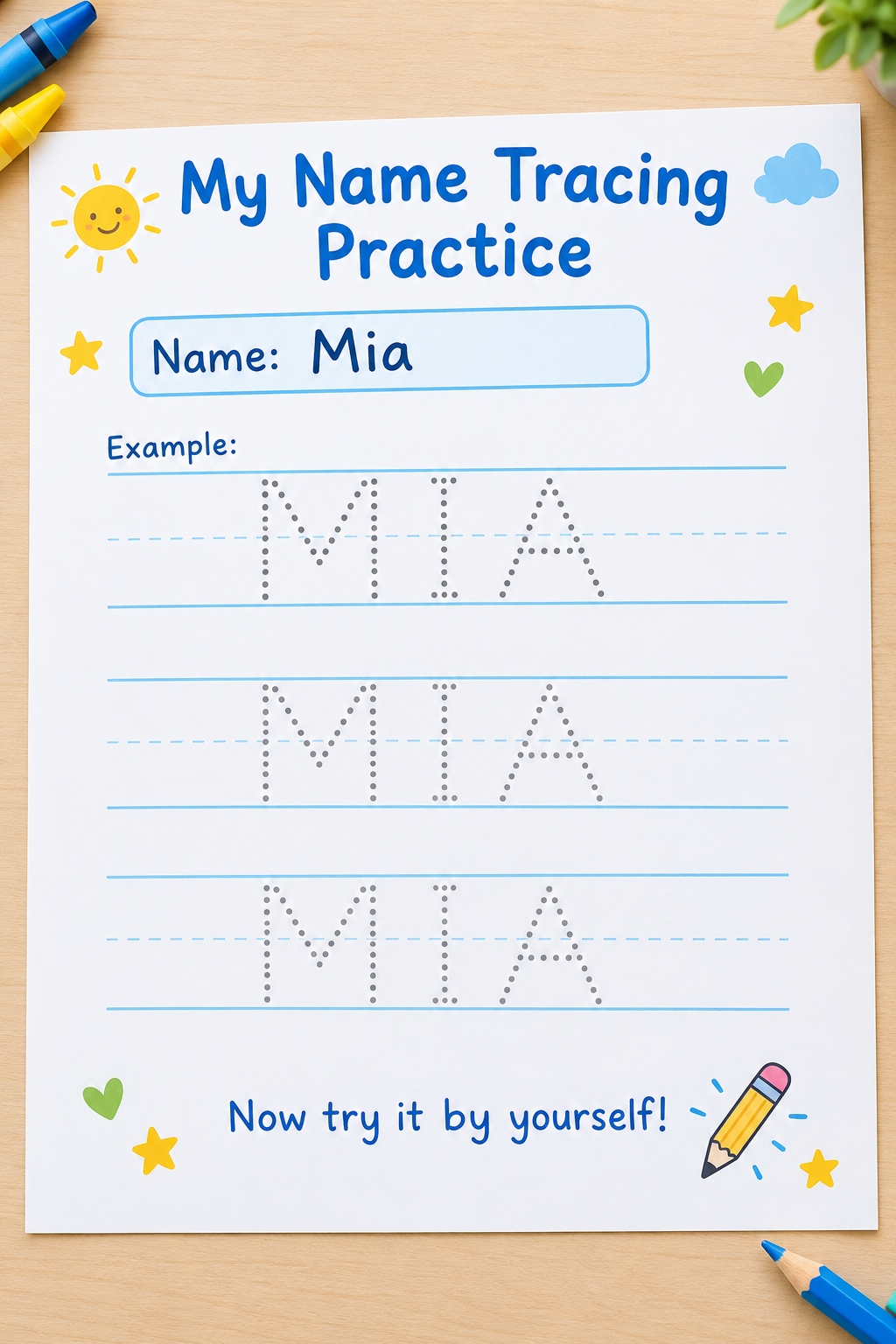

Free name tracing worksheets for preschool are printable learning pages that help young children recognize the letters in their names and practice forming those letters with a pencil or crayon. Parents and teachers can use worksheets with dotted letters, handwriting guides, and blank practice lines to support early writing skills. The best approach is to make practice short, enjoyable, and suitable for each child’s current ability rather than expecting perfect handwriting immediately.
Free Name Tracing Worksheets for Preschool
Introduction
Learning to write their own name is an important early literacy activity for preschool children. Before children can write complete sentences, they can begin by recognizing the letters in their names, following simple letter patterns, and experimenting with pencil movements. Free name tracing worksheets for preschool offer parents, caregivers, and teachers a simple way to introduce these skills through printable activities.
These worksheets typically include a child’s name written in dotted letters, spaces for tracing, and blank lines for independent practice. Some designs focus on uppercase letters, while others use lowercase letters, handwriting guides, or a combination of tracing and free writing.
Parents can print these pages for home learning, and preschool teachers can include them in handwriting centers, morning routines, or early literacy lessons. Because the child’s own name is meaningful and familiar, name-writing practice can be a useful starting point for exploring letters and written language.
The National Association for the Education of Young Children (NAEYC) explains that name writing is an important part of young children’s emerging writing development. It also recommends giving children regular opportunities to experiment with writing while respecting differences in their developing skills.
Featured visual: An example of a preschool name-tracing worksheet.
What Are Free Name Tracing Worksheets for Preschool?
Free name tracing worksheets are printable pages designed to help young learners practice writing their first names or other familiar names. They provide a visual example that children can follow with a pencil, crayon, or another age-appropriate writing tool.
Unlike blank paper, a tracing worksheet gives children a clear pattern to follow. This can help them notice how letters are shaped, where they begin, and how they fit together to form a name.
Common worksheet features include:
- Dotted name letters: Children trace over dots that form each letter.
- Handwriting lines: Horizontal guides help children understand where letters sit on the page.
- Name examples: A printed name provides a model for children to copy.
- Blank practice spaces: Children can attempt to write their names without tracing.
- Uppercase and lowercase letters: Some worksheets introduce both forms.
- Child-friendly illustrations: Simple pictures make the activity more inviting.
- Personalized name fields: Certain worksheet tools allow adults to enter a child’s name before printing.
Not every printable includes all these features. Parents should choose a layout that suits the child’s current writing experience and keeps the activity manageable.
Why Is Name Writing Important in Preschool?
A child’s name is a meaningful word that appears on belongings, artwork, classroom labels, books, and school materials. Practicing it can connect early writing activities with something the child already recognizes.
NAEYC’s article, Promoting Preschoolers’ Emergent Writing, describes name writing as one of the important experiences through which young children develop their understanding of written language.
Name tracing can support several areas of early learning.
1. Recognizing Letters
When children repeatedly see their names, they can begin noticing the letters that make them up. A worksheet may help them identify the first letter and observe which letters appear more than once.
For example, a child named Mia can learn to recognize M, I, and A. An adult can point to each letter, say its name, and invite the child to find the same letter elsewhere.
The activity should not become a test. Children can learn gradually through repeated exposure and conversation.
2. Practicing Pencil Control
Tracing gives children an opportunity to move a writing tool along a visible path. They can practice making straight lines, curves, and angled strokes.
These movements are part of the broader development of fine motor control. However, a worksheet is only one activity among many. Drawing, coloring, using play dough, painting, and manipulating small age-appropriate objects can also provide opportunities to develop hand skills.
3. Understanding That Written Letters Have Meaning
A name is more than a sequence of shapes. It identifies a person and appears in everyday situations.
When a child writes their name on a drawing or labels a project, they begin to see that writing serves a purpose. Adults can reinforce this idea by explaining what the name says and where it will be used.
4. Building Confidence
Children may feel proud when they recognize or attempt to write their own names. A worksheet with a clear example gives them a starting point without requiring them to create every letter independently.
Praise the child’s effort and progress. For example, you might say, “You remembered how to start your M,” instead of focusing only on whether the entire name looks perfect.
5. Preparing for Broader Literacy Activities
Name tracing can introduce children to letter shapes, familiar print, and the process of writing from a model. These experiences may provide a useful foundation for later writing activities.
Still, tracing a name does not automatically mean a child can write other words independently. Children also need opportunities to explore sounds, letters, drawing, storytelling, and meaningful writing.
Types of Free Preschool Name Tracing Worksheets
Different worksheet designs support different stages of early writing. Choosing the right format can make the activity more useful and less frustrating.

1. Dotted Name Tracing Worksheets
These pages show a name in dotted or dashed letters. Children follow the dots to practice the letter shapes. They are a practical starting point for children who are learning to use a writing tool and follow a model.

2. Uppercase and Lowercase Name Worksheets
These worksheets introduce different forms of letters. For example, a child might see the name “Mia” and learn to distinguish uppercase M from lowercase i and a. Start with the form most appropriate for the child’s learning stage.

3. Trace-and-Write Worksheets
These pages combine tracing with blank writing lines. A child traces the example first and then attempts the name independently. This format can gradually introduce more independence.

4. Picture-Based Name Worksheets
Simple illustrations, stars, animals, or other child-friendly decorations can make a page more inviting. Choose designs that leave enough space for large letters and avoid distracting children from the writing task.
How to Choose the Best Name Tracing Worksheet for Your Child
A useful worksheet should match the child’s current skills, not simply look attractive.
Choose large, clear letters
Preschool children may find small letters and narrow writing spaces difficult to follow. Look for generous spacing, clearly printed letter shapes, and handwriting guides that are easy to see.
Start with the first name
A long name can require many letter movements. If a child is just beginning, practice the first letter or a short section of the name before introducing the entire word.
For example, a child named Alexander might begin with A and then gradually work toward tracing the full name.
Look for simple instructions
Young children benefit from activities they can understand quickly. A worksheet with one clear example and a few practice lines may be more useful than a crowded page containing several unrelated tasks.
Consider uppercase and lowercase forms
Some worksheets use all uppercase letters, while others display a name with an uppercase initial followed by lowercase letters. Either can be used for an appropriate learning purpose.
If your child is learning to recognize their name as it normally appears in books or on classroom labels, include opportunities to see the usual capitalization of that name.
Use printable pages that are easy to read
For home printing, check that the worksheet fits the paper size you use and that the lines and dotted letters remain visible. Print a test page before preparing a large set for a classroom.
How to Use Free Name Tracing Worksheets at Home
You do not need a complicated lesson plan to introduce name tracing. A few minutes of guided practice can provide a useful learning opportunity.
Step 1: Show the child’s name
Write or print the child’s name clearly at the top of the page. Read it aloud together and point to each letter.
Ask simple questions, such as “Can you find the first letter of your name?” Give the child time to respond without pressure.
Step 2: Demonstrate how to trace
Use your finger to follow a letter before handing over the pencil. Show the child where to begin and how to follow the shape.
Do not expect every child to follow the exact direction immediately. Some children need repeated demonstrations and opportunities to explore the letter movements.
Step 3: Let the child trace
Invite the child to trace the dotted letters slowly. Offer help when needed, but allow them to try independently where possible.
Use a pencil, thick crayon, or another writing tool that is comfortable for the child’s hands.
Step 4: Move to a blank line
After tracing, encourage the child to try writing the name on a blank line. It is fine if the letters are uneven, reversed, or incomplete during early attempts.
If independent writing is too challenging, return to tracing or practice just the first letter.
Step 5: Finish with a meaningful activity
Ask the child to write or attempt their name on a drawing, greeting card, pretend shopping list, or classroom-style sign-in sheet.
This connects the worksheet to everyday writing instead of treating it as an isolated exercise.
Free Name Tracing Worksheets for Different Preschool Ages
Children develop writing skills at different rates. Age ranges can help adults choose activities, but they should not be treated as strict deadlines.
| Approximate age | Suggested activity | Adult support |
|---|---|---|
| Around 2–3 years | Drawing, scribbling, exploring letter shapes, and noticing the first letter of a name | Demonstrate, talk about marks, and offer varied writing materials |
| Around 3–4 years | Tracing a first letter or short name, with large examples | Model the movement and offer help as needed |
| Around 4–5 years | Tracing a full first name and attempting some letters independently | Encourage practice and gradually reduce assistance |
| Around 5 years | Combining name tracing with copying, independent attempts, and other early writing activities | Offer feedback while allowing room for individual development |
These are general suggestions, not diagnostic milestones. The U.S. Head Start early learning resources describe preschool writing as a progression that can include drawing, scribbling, letter-like forms, and increasingly intentional writing. Some children may write recognizable names earlier, while others need more time and practice.
Creative Ways to Practice Name Writing Without a Worksheet
Free printables are useful, but children do not have to work on paper every time they practice writing.
Try these simple activities:
- Write in the air: Ask children to use a finger to make large letter shapes in the air.
- Practice with a whiteboard: Let children trace a name written by an adult, then erase it and try again.
- Use play dough: Roll dough into long pieces and shape the first letter of the child’s name with supervision.
- Make a name card: Create a card with the child’s name and place it near their artwork or belongings.
- Use washable chalk: Practice large letters on a suitable outdoor surface.
- Make a name collage: Use paper letters to assemble the name before attempting to write it.
- Create a sign-in routine: Invite children to write or attempt their names when starting an activity.
NAEYC’s family resource, Support Writing at Home, recommends making writing materials available in everyday environments and encouraging children’s early attempts at writing.
These activities can complement tracing worksheets by allowing children to explore letters in different ways.
Tips for Parents and Teachers
The way adults introduce name tracing can influence whether the activity feels encouraging or frustrating.
Keep practice sessions manageable
Begin with a short activity and stop when the child loses interest or becomes tired. There is no need to complete every line on a page.
Praise effort and progress
Recognize attempts, such as following a dotted line, noticing the first letter, or remembering a letter shape. Avoid comparing one child’s handwriting with another’s.
Avoid demanding perfect handwriting
Preschool is a period of exploration. A child may make marks that resemble letters, write only the first letter, or form some letters inconsistently. These attempts can be part of early writing development.
Offer different writing tools
Thick crayons, washable markers, chalk, and pencils provide different experiences. Choose tools that are safe and suitable for the child’s age and abilities.
Make the child’s name personal
Use the name in real activities, such as labeling a picture or signing a handmade card. This helps children understand why people write names.
Respect individual differences
Some children need more modeling, larger letters, fewer practice lines, or additional time. Adapt the worksheet rather than expecting every child to use it in the same way.
Remember that tracing is only one part of learning
Children also benefit from drawing, listening to stories, talking about letters, playing with language, and seeing adults write for meaningful purposes. A balanced approach is more useful than relying on worksheets alone.
How to Print and Organize Name Tracing Worksheets
Printable worksheets are convenient for families and classrooms because they can be prepared as needed.
- Choose a worksheet with clear lettering and sufficient writing space.
- Enter the child’s name if the worksheet allows personalization.
- Preview the page to make sure the name and letters are displayed correctly.
- Print on standard paper or another suitable paper size supported by your printer.
- Check that the dotted letters and handwriting lines are visible.
- Keep a small selection of pages in a folder for future practice.
For repeated classroom use, organize pages by the child’s name or place them in individual learning folders. If you are printing for several children, check spelling and letter capitalization before distributing the worksheets.
When choosing online printables, review the website’s terms of use. A worksheet described as free may be free for personal use but have different restrictions for commercial use, redistribution, or inclusion in a product bundle.
Where Can You Find Free Name Tracing Worksheets for Preschool?
Several options are available, depending on whether you need a ready-made printable or a worksheet personalized with a child’s name.
- Ready-made printable worksheets: Search for preschool name tracing printables with dotted letters and large handwriting lines. Check whether the PDF can be downloaded without payment or an account.
- Personalized name worksheets: Some online generators let adults enter a name and select a tracing style. For example, NameTracing.org’s preschool name tracing page offers a name-tracing worksheet tool. Review its current download options and terms before use.
- Early literacy guidance: NAEYC and Head Start offer information about supporting children’s early writing. These resources can help parents and teachers use printables in an age-appropriate way.
- Homemade worksheets: Adults can write a child’s name in large letters, add tracing dots where appropriate, and provide blank lines underneath. A simple homemade page can be enough for a short practice activity.
If you are preparing a printable collection for home or classroom learning, consider including more than one difficulty level. For example, a set might start with the first letter, move to tracing the full name, and finish with a blank line for independent attempts.
What to Look for in a High-Quality Printable Worksheet
A useful name tracing page should make the writing task clear and accessible.
Look for these features:
- Large letters with easy-to-follow shapes.
- Visible dotted or dashed tracing lines.
- Enough space between letters.
- Handwriting guides that do not crowd the page.
- A clear example of the child’s name.
- Optional blank lines for independent practice.
- Simple illustrations that do not overwhelm the writing area.
- A printable layout that remains legible on paper.
Avoid pages that are crowded with tiny letters or too many unrelated tasks. For a beginner, one clear name repeated a few times may be more appropriate than a full page of small writing exercises.
Why Free Name Tracing Worksheets Can Be Useful for Busy Families
Free printables can make it easier to prepare an activity without purchasing a workbook. Parents can print one page when a child wants to practice, while teachers can prepare individual sheets for a writing center.
They are also flexible. An adult can adjust the amount of practice, select a child’s first name, or combine tracing with drawing and letter-recognition activities.
However, a free worksheet is not automatically suitable for every child. Check the letter size, difficulty, and instructions before using it. The goal is to provide an accessible starting point for writing—not to finish a page as quickly as possible.
For a broader early literacy routine, pair name tracing with reading picture books, talking about letters, drawing, and letting children see how writing is used in daily life.
What Happens Next in a Child’s Name-Writing Journey?
Name tracing is one possible starting point, not a final goal. As children become more comfortable with letters, adults can gradually introduce different activities.
A child might begin by recognizing the first letter, then trace several letters, copy a familiar name, and eventually attempt to write it without a model. Progress may not follow this exact sequence, and some children may move back and forth between activities.
The next useful step is to observe what the child can do comfortably and offer a slightly more challenging activity when they are ready.
For example, if a child can trace their first name with ease, offer a blank line to try copying it. If that is difficult, provide another tracing example or practice a single letter. Continue to make writing meaningful and encouraging.
There is no need to turn preschool name writing into a competition. Children benefit from opportunities to explore letters at their own pace, with adults who support their curiosity.
Frequently Asked Questions (FAQs)
1. What are free name tracing worksheets for preschool?
They are printable pages that help preschool children practice recognizing and tracing the letters in their names. Many include dotted letters, handwriting guides, and blank lines for additional practice.
2. At what age can children start name tracing?
Children can be introduced to names and letter shapes during the preschool years, but readiness varies. Younger children may begin with drawing, scribbling, or recognizing the first letter, while others may be ready to trace a full name.
3. Are name tracing worksheets good for preschoolers?
They can be a useful part of early writing practice. Worksheets provide a visible model for tracing letters, but they should be combined with other activities such as drawing, playing with letters, reading, and experimenting with writing.
4. How often should preschoolers practice name tracing?
There is no single schedule that suits every child. Short, enjoyable opportunities can be incorporated into a regular routine. Stop or change activities if the child becomes frustrated or loses interest.
5. Should preschool children trace uppercase or lowercase letters?
The best choice depends on the child’s current learning needs. Some activities begin with uppercase letters because they can be easier to distinguish visually, while others use the usual capitalization of the child’s name. Children can gradually become familiar with both forms.
6. How can I make a name tracing worksheet for my child?
Write the child’s name clearly in large letters, provide a few tracing examples or dotted letters, and add blank handwriting lines. You can also use an online worksheet generator that allows you to enter a name and choose a style.
7. What if my child cannot trace the whole name?
Start with one letter or a shorter section of the name. Demonstrate the movement, offer larger letters, or use a finger-tracing activity before introducing a pencil. Allow the child to progress gradually.
8. Are free printable name tracing worksheets suitable for kindergarten?
Yes. They can be useful for children who are learning to write their names or want additional practice. Kindergarten children who already trace confidently may benefit more from copying their names or trying to write them independently.
Conclusion
Free name tracing worksheets for preschool offer a simple way to introduce name recognition and early handwriting practice. With clear dotted letters, generous writing space, and an opportunity to try writing independently, a printable page can become a useful part of a child’s learning routine.
Parents and teachers should choose worksheets that match the child’s abilities, keep practice enjoyable, and celebrate progress rather than perfect results. Combining printables with drawing, letter games, stories, and everyday writing experiences can help children explore written language in meaningful ways.
The most important goal is not to complete every worksheet. It is to help children become increasingly comfortable with letters, their own names, and the idea that writing has a purpose.



