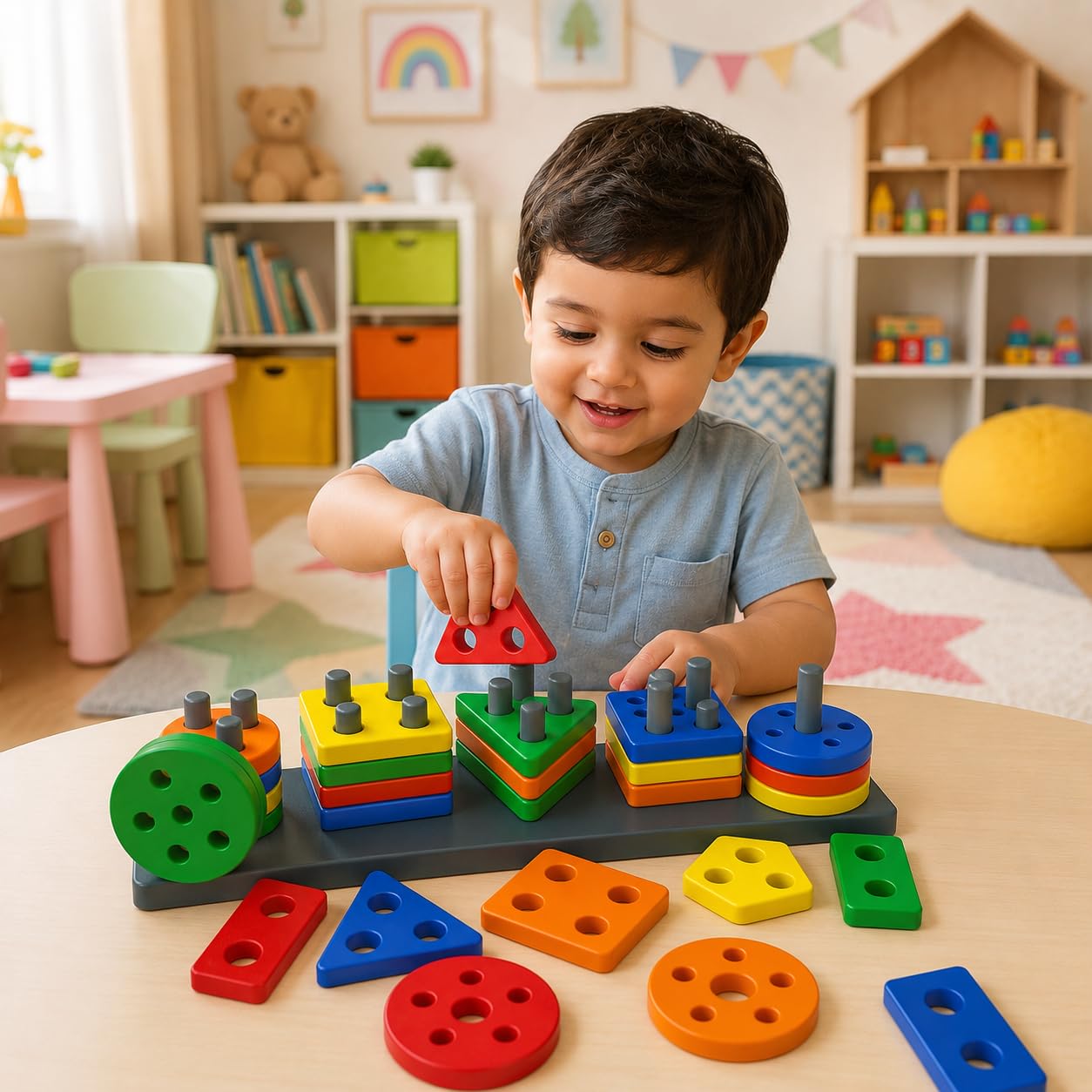

Parents shopping for kids toys on Amazon India can choose from building blocks, puzzles, pretend-play sets, craft kits, flash cards and many other categories. The best toy depends on the child’s age, interests, abilities, available space and the family’s budget. Before purchasing, check the recommended age, small-parts warnings, material and care instructions, seller information, and applicable BIS toy-safety requirements.
Kids Toys on Amazon India — Educational Picks, Prices and a Parent’s Buying Guide
Introduction
Choosing kids toys is easier when parents start with what a child enjoys and what the toy is intended to do. Some children like constructing things with blocks, while others prefer solving puzzles, playing pretend shop, drawing or exploring simple games. Amazon India offers products across these categories, making it possible to compare styles and prices before buying.
But a toy does not need to be electronic, expensive or labelled “educational” to be worthwhile. Simple materials can support play when they are suitable for the child’s age and used in an engaging way. Building blocks, for example, can be used to create structures, while puzzles invite children to look for patterns and fit pieces together.
The key is to match the toy to the child rather than choosing solely by advertising claims or the number of pieces included. Parents should also consider safety, durability, storage space and whether the toy can be used in more than one way.
This guide explores popular kids toys available online, gives examples of product listings, explains how different categories can be used, and outlines the safety checks worth making before placing an order.
Shopping note: This is a general product guide, not a report of a new product launch. Prices and availability can change, and the examples below are not independent product-test results.
What Types of Kids Toys Can You Find on Amazon India?
1. Building blocks and construction toys
Building blocks allow children to stack, connect and rearrange pieces to create different structures. Depending on the design, children might make towers, houses, vehicles or imaginative creations.
These toys can encourage experimentation and problem-solving through play. Parents can start with a simple challenge, such as building a bridge for a toy car, and let the child experiment with different arrangements.
When buying building blocks, check the recommended age and the size of each piece. Small blocks may be unsuitable for children who still put objects in their mouths. Also check whether the set includes instructions, a storage container or accessories shown in the product photographs.
2. Puzzles and matching games
Puzzles come in many forms, including chunky puzzles for younger children, jigsaw puzzles, floor puzzles and matching games.
A suitable puzzle gives a child a manageable challenge. A very difficult puzzle can become frustrating, while one that is too easy may not hold the child’s attention for long.
Look for clear illustrations, sturdy pieces and an age recommendation that fits the child. For younger children, larger pieces may be easier to handle, but always check the product’s specific safety warnings.
3. Pretend-play toys
Pretend-play toys include toy kitchens, food sets, shop counters, tool sets and other role-play accessories. Children can use them to act out familiar situations, invent stories and play with siblings or adults.
A pretend kitchen set, for example, can be used to create a make-believe restaurant. A parent can introduce simple concepts such as sorting, counting or taking turns without turning the activity into a formal lesson.
Check for small accessories, detachable components and any battery-powered features. For toys with lights or sounds, review the battery compartment and the manufacturer’s instructions.
4. Flash cards and early-learning toys
Flash cards may cover letters, numbers, colours, shapes, animals or vocabulary. They can be used for short, interactive activities at home or in a classroom.
For preschool children, keep sessions playful and brief. A parent can ask the child to find a particular colour, match a picture or name an object. Avoid expecting every child to learn at the same pace.
Check the language, print size, image clarity and recommended age. A set with many cards is not automatically better if the cards are confusing or unsuitable for the child.
5. Art and craft kits
Art and craft kits can include drawing supplies, stickers, paper activities, painting materials or age-appropriate projects. They may suit children who enjoy creating their own pictures and objects.
Before buying, inspect the age recommendation and the contents. Check whether materials are washable, whether adult supervision is required and whether any components could be choking hazards. Follow the product’s instructions, especially for paints, adhesives and tools.
6. Games and activity toys
Board games, simple matching games, construction challenges and other activity toys can provide opportunities for shared play. Some encourage taking turns or following rules; others allow children to explore independently.
Choose games with instructions that the child can understand with age-appropriate help. For family play, consider the number of players, average playing time and whether the game can be adapted for younger participants.
Kids Toys on Amazon India: Product Examples and Prices
These are examples from retrieved listings that represent different types of play. They are not a ranking, and a product’s listing or customer rating should not be treated as proof of safety or educational effectiveness.

MBK 100-Piece DIY Building Blocks Toy Set for Kids – Fun Puz…
₹149
Merchant: Amazon.in
A 100-piece building-block set marketed for young children. Check the size of the pieces, recommended age and whether the set’s components are suitable for your child.

Ratnas Ratna 4 in 1 Indian Seasons Jigsaw Puzzle
₹179
Merchant: Amazon.in + others
A four-in-one Indian seasons jigsaw puzzle listing. It may appeal to children who enjoy picture-based activities; check the number and size of pieces and the recommended age.

Storio Kitchen Set for Girls Kids Kitchen Set with Gas Sound…
₹799
Merchant: Amazon.in + others
A pretend kitchen playset listing with advertised sound and light features. Before buying, check which accessories are included, how the toy is powered and whether small parts require extra caution.

Intelliskills Jungle Animals Jigsaw Puzzle 18 Piece Educatio…
₹188.99
Merchant: Amazon.in + others
An 18-piece jungle-animal jigsaw puzzle listing marketed for children aged two and above. Verify the current age guidance and piece dimensions before purchase.
Prices shown are retrieved listing prices, not guaranteed current offers. Product specifications, stock, seller details and delivery availability may change.
You can also browse kids toys on Amazon India to compare current options by age, category and budget.
How to Choose Age-Appropriate Kids Toys
Age labels are a useful starting point, but parents should also consider a child’s abilities, interests and behaviour.
Toys for babies and young toddlers
For very young children, look for toys designed specifically for their age group. Consider whether the toy is easy to hold, clean and inspect.
Avoid products with accessible small parts, loose components or other hazards that are unsuitable for the child. Check all warnings and follow the manufacturer’s instructions.
Toys for children aged 2–3
Children in this age range may enjoy simple puzzles, larger construction pieces, pretend-play items and activities involving sorting or matching. The best choice depends on the individual child’s development and interests.
Pay particular attention to choking hazards. A toy marketed broadly for “kids” may still contain pieces that are unsuitable for a toddler.
Toys for preschoolers aged 3–5
Preschoolers may enjoy building, drawing, pretend play, matching games and age-appropriate puzzles. These activities can be adapted to different interests and abilities.
Choose toys that the child can use with manageable assistance. An open-ended toy, such as building blocks, may allow several kinds of play rather than only one fixed activity.
Toys for school-age children
Older children may enjoy more complex construction sets, board games, science activities, crafts or challenging puzzles. Check the instructions, complexity and any tools or small components included.
A toy should offer a suitable challenge without relying on age labels alone. A child’s interests can help determine whether a particular set is likely to be used regularly.
Educational Toys vs. Toys for Open-Ended Play
Parents often compare educational toys with toys chosen mainly for fun. In practice, the categories can overlap.
Educational toys may focus on a particular activity, such as matching letters, identifying shapes or completing a puzzle. They can provide a structured way to practise a skill when the activity suits the child.
Open-ended toys include items such as blocks, pretend-play accessories and art materials that can be used in many ways. They allow children to decide what to create or how to play.
Neither category is automatically superior. A child may benefit from a mix of activities, including independent play, shared games, physical movement, creative projects and everyday interaction with adults.
Be cautious about product descriptions that promise guaranteed intelligence gains, faster development or exceptional academic results. A product listing alone does not establish such outcomes.
What to Check Before Buying Kids Toys Online
1. Read the age recommendation and warnings
Do not choose a toy solely because it appears colourful or entertaining. Check the age range, instructions, warnings and any adult-supervision requirements.
2. Check for small parts
Small components can present a choking hazard for young children. Inspect the product details and consider whether pieces could detach during normal play.
If a toy is intended for an older child but will be used around younger siblings, consider how it will be stored between play sessions.
3. Review the materials and construction
Look for clear product information and inspect the toy when it arrives. Check for sharp edges, cracks, loose components, exposed wires or damaged packaging.
For craft materials, read the ingredient and handling information provided by the manufacturer. Do not assume that every material is suitable for every age.
4. Check electrical and battery-powered features
Toys with lights, sounds or motors may require batteries or charging. Check whether batteries are included, how the compartment is secured and what the manufacturer says about charging and maintenance.
Adults should handle damaged batteries and charging equipment. Stop using a toy if it shows signs of overheating, electrical damage or a broken battery compartment.
5. Compare what is actually included
A product photograph may show accessories, props or storage containers that are not part of the package. Read the listed contents carefully before comparing prices.
Also check whether the toy requires separate batteries, refills or other materials for regular use.
6. Check the seller, reviews and return terms
Review the seller details, delivery availability, warranty information and return conditions. Recent customer reviews may reveal recurring issues, but individual experiences do not guarantee the same result for every buyer.
Do not rely on a high star rating as the only sign of quality or safety.
What Do Indian Toy-Safety Authorities Say?
In India, toy safety is addressed through the Toys (Quality Control) Order, 2020, issued by the Department for Promotion of Industry and Internal Trade (DPIIT), Ministry of Commerce and Industry. The order establishes requirements for toys within its scope, including conformity with applicable Indian Standards and the required BIS Standard Mark under a licence. The BIS explains the certification framework in its official guidance.
BIS distinguishes between non-electric toys and electric toys for certification purposes. Its published FAQ identifies IS 9873 (Part 1) as the primary standard for non-electric toys and IS 15644 as the standard for electric toys within the relevant scope.
For parents buying kids toys online, this means checking the applicable safety and certification information rather than relying only on the product title or marketplace reviews. The precise requirements depend on the product and its scope; not every listing can be assessed from a photograph alone.
Official resources:
- BIS: Safety of Toys
- BIS: Products under compulsory certification
- Government of India: Toys (Quality Control) Order, 2020
Why Choosing the Right Kids Toys Matters
The right toy can give children an enjoyable way to explore, create, solve problems or act out familiar experiences. However, the value of a toy depends on how it suits the child and how it is used.
For example:
- Building blocks can be used to experiment with shapes and structures.
- Puzzles invite children to match pieces and notice visual details.
- Pretend-play sets can inspire stories and role-play.
- Art materials give children opportunities to make and express their own ideas.
- Matching cards can be used for short activities involving pictures, colours or vocabulary.
These are possible uses, not guaranteed developmental outcomes. Children differ in their interests, and an expensive or highly advertised toy is not automatically more beneficial than a simpler option.
Parents can also extend play without buying more products. A set of blocks can become a pretend town, while a puzzle can lead to a conversation about the pictures. Allowing children to explore at their own pace can make play more enjoyable than requiring them to follow a fixed result.
What Happens Next for Parents Shopping on Amazon India?
There is no single breaking-news development associated with the general keyword “kids toys.” It refers to a broad category of products sold by many brands and retailers.
For shoppers, the most useful next step is to shortlist products according to the child’s age, interests and intended use.
- Choose a category: blocks, puzzles, pretend play, crafts, games or another type of toy.
- Check age suitability: read the warnings and recommended age.
- Compare the complete product: inspect package contents, materials, dimensions and any battery requirements.
- Review safety information: check the manufacturer’s details and applicable certification information.
- Compare current prices: review seller information, delivery availability, warranty and return conditions.
- Inspect the toy after delivery: check for damage, missing parts and clear instructions before letting the child use it.
The best choice is the one that fits the child, the available budget and the family’s needs—not necessarily the toy with the most pieces, the most features or the biggest advertised discount.
Frequently Asked Questions
1. Which kids toys are best for learning?
Building blocks, puzzles, matching games, flash cards and age-appropriate craft activities can all provide opportunities for learning through play. Choose based on the child’s age, interests and abilities rather than relying on broad educational claims.
2. Where can I buy kids toys online in India?
You can compare kids toys on Amazon India. Review current prices, product details, seller information, age recommendations and return conditions before ordering.
3. Which toys are suitable for children aged 2–3?
Depending on the child’s abilities, suitable options may include larger building pieces, simple puzzles and pretend-play toys designed for that age range. Always check the manufacturer’s age recommendation and small-parts warnings.
4. Are expensive toys better than inexpensive toys?
Not necessarily. Price alone does not establish quality, safety or educational value. Compare construction, suitability, usability, included accessories and safety information before deciding.
5. What should I check before buying kids toys on Amazon India?
Check the recommended age, warnings, material information, package contents, seller details and return policy. For toys covered by India’s compulsory toy-safety requirements, check the applicable certification information as well.
6. What is the BIS certification requirement for toys in India?
The Toys (Quality Control) Order establishes requirements for toys within its scope, including conformity with applicable Indian Standards and the required BIS Standard Mark under a licence. Consult the official BIS guidance for details.
7. Are electronic toys suitable for young children?
Suitability depends on the particular toy, the child’s age and the manufacturer’s instructions. Check battery safety, electrical components, small parts and supervision requirements. A toy with lights or sounds is not automatically more suitable than a non-electric alternative.
8. How much do kids toys cost on Amazon India?
Prices vary widely by category, brand, materials and features. The examples retrieved for this guide included building blocks at around ₹149, a jigsaw puzzle at around ₹179 and a pretend kitchen set at around ₹799. These are indicative listing prices, not guaranteed current offers; check the live listings for current pricing and availability.