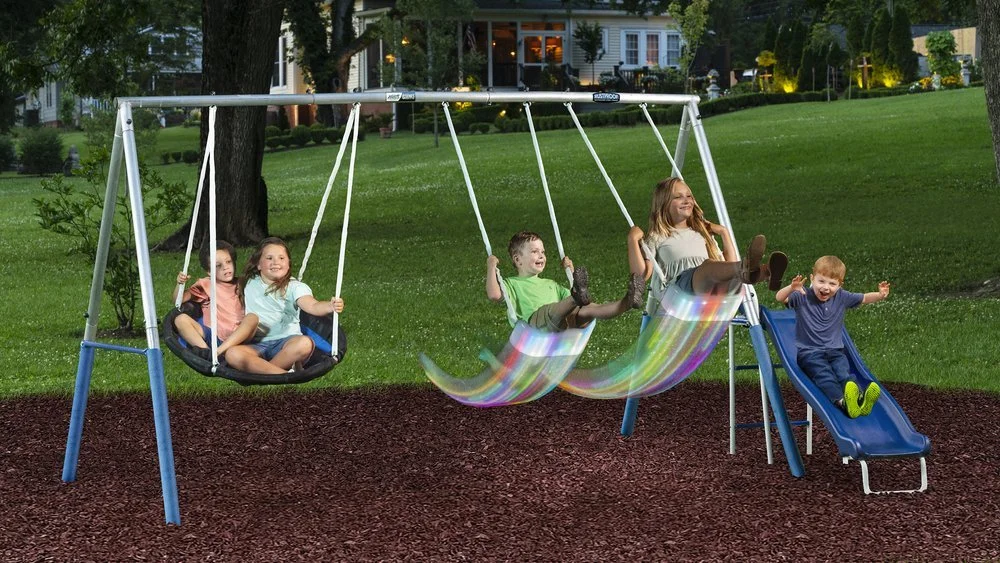

A swing for kids can provide enjoyable movement-based play at home, in a garden or on a playground, but the right choice depends on the child’s age, the available space and the product’s intended use. India’s Bureau of Indian Standards (BIS) includes IS 9873 (Part 4) for the safety of swings, slides and similar activity toys intended for indoor and outdoor family use. Parents should check age guidance, seat support, suspension hardware, stability, installation and protective ground surfacing before letting a child use a swing.
News context: No specific new swing launch or breaking announcement is verified here. This article explains the relevant safety standards and practical considerations for families choosing a swing for children.
Swing for Kids — Types, Benefits, Safety Standards and Buying Guide
Introduction
A swing for kids can turn a garden, balcony play area, bedroom corner or playground into a space for active play. Families can choose from baby swings with supported seats, toddler swings, traditional outdoor swing sets, indoor hanging swings and larger garden models. Each type has different space requirements, age recommendations and installation needs.
For Indian parents, product safety is an important part of the buying decision. BIS lists IS 9873 (Part 4) as the Indian Standard covering the safety of swings, slides and similar activity toys for indoor and outdoor family domestic use. BIS documentation also records technical requirements relating to swing stability, suspension connections, strength and clearance around moving components.
There is no single swing that suits every child or home. A baby who needs a supportive seat has different requirements from a school-age child who uses an outdoor swing set. Parents should match the product to the child’s age and abilities, follow the manufacturer’s installation instructions and supervise play.
What Happened? Understanding the Swing for Kids Buying Trend
The search term “swing for kids” covers a broad range of products rather than one specific product launch. Parents may be looking for a compact indoor swing, a baby swing for supervised use, a toddler seat, a garden swing set or a playground-style swing for several children.
These options serve different purposes. Some are designed for young children who need additional body support, while others require the child to sit independently and hold on securely. Outdoor swing sets also need sufficient clearance and suitable ground surfacing.
The important development for shoppers is the availability of an Indian safety standard specifically covering swings and related activity toys. BIS identifies IS 9873 (Part 4) in its product certification information, and a 2022 BIS circular documents changes to the standard’s requirements.
This is not evidence of a new nationwide swing launch or a recent product recall. It is relevant background for parents comparing products and checking safety claims.
Key Details: Types of Swings for Kids


1. Baby swings
Baby swings are designed for very young children, but age suitability varies significantly by model. Some products are powered infant swings intended for supervised use, while others are suspended seats designed for a particular age and development stage.
Before buying, check the manufacturer’s minimum and maximum age, weight limits, required head and body support, and instructions for restraint systems. Never assume a swing is suitable for a newborn simply because it is marketed as a baby product.
Important: A baby swing is not a substitute for a safe sleep surface. If an infant falls asleep in a swing, follow pediatric safe-sleep guidance and move the baby to an appropriate flat, firm sleep surface as soon as practical.
2. Toddler swings
Toddler swings often use a bucket-style seat, a high back or a restraint system intended to help the child remain seated. These features may be useful for children who are not ready for a conventional flat swing seat.
Check that the seat fits the child properly and that any belt or restraint is used exactly as instructed. A child should never be left unattended, and a restraint should not be treated as a replacement for supervision.
BIS’s technical material includes separate considerations for swings intended for children under 36 months, demonstrating why age-specific design matters.
3. Traditional outdoor swings

Traditional outdoor swings may have a flat seat, a flexible seat or a molded design. They can be part of a standalone frame or a larger play structure.
Parents should check the frame’s stability, the condition of the suspension ropes or chains, the seat material and the manufacturer’s instructions for anchoring. The swing should be installed with enough room for the seat to move without hitting walls, trees, fences or other equipment.
4. Indoor swings
Indoor swings can be useful when outdoor space is limited. Depending on the design, they may be suspended from a purpose-built frame or an approved structural mounting point.
The key concern is installation. A ceiling hook or beam should not be assumed strong enough to support a swinging load simply because it can hold a stationary object. Dynamic movement puts different forces on mounting points.
Use only mounting hardware and structures approved for the product, and seek qualified installation help where required. Do not attach a swing to an unverified ceiling fitting, curtain rod or other unsuitable support.
5. Garden swings with a frame
Garden swing sets are available in a variety of sizes and materials. Some have one seat, while others include two or more seats or additional play equipment.
Check the full footprint, including the space needed in front of and behind the swing. Large outdoor models may require anchoring and a protective surface under the play area.
The US Consumer Product Safety Commission (CPSC) recommends extending protective surfacing for swings to the front and rear by a distance equal to twice the height of the bar from which the swing is suspended. This is US guidance; follow the applicable local requirements and the manufacturer’s instructions for your installation.
Background: What Is the Indian Safety Standard for Swings?
The Bureau of Indian Standards is India’s national standards body. Its official product certification information lists IS 9873 (Part 4):2017, titled Safety of Toys — Part 4: Swings, Slides and Similar Activity Toys for Indoor and Outdoor Family Domestic Use.
BIS also published a circular dated April 5, 2022, describing implementation of Amendment No. 1 to IS 9873 (Part 4):2017, which it said had been published and implemented from March 21, 2022. The changes included requirements concerning swing clearance, lateral stability, ground clearance and related test procedures.
The standard’s technical scope is relevant because swing safety depends on more than the seat itself. The complete structure includes the frame, crossbeam, suspension connectors, moving seat and surrounding space.
However, parents should distinguish between three separate things:
- A standard exists: BIS publishes a standard describing relevant safety requirements.
- A product claims compliance: A seller or manufacturer says a particular model meets a standard.
- A product’s compliance is verified: Appropriate documentation or certification supports the claim for that specific product.
A general statement such as “safe for kids” does not independently prove compliance. If a seller advertises a BIS mark or licence, check that the details match the product and manufacturer. The applicable certification requirements may depend on the product category and current rules.
What Officials and Organizations Say About Swing Safety
BIS documentation provides technical requirements for swings and similar activity toys, including stability and suspension-related issues. Its published circular on IS 9873 (Part 4) records amendments addressing several of these areas.
The CPSC, which oversees consumer product safety in the United States, also publishes guidance for residential playground equipment. Its home playground information identifies falls, entanglement, entrapment and equipment tipping or structural failure among the hazards associated with home play equipment. The commission’s handbook recommends protective surfacing and regular equipment checks.
The American Academy of Pediatrics’ parent-facing resource, HealthyChildren.org, similarly recommends close supervision, secure installation, appropriate impact-absorbing surfacing and regular inspection of home playground equipment. It advises against attaching ropes, jump ropes, clotheslines or pet leashes to play equipment because they can create strangulation hazards.
These recommendations offer useful safety guidance, but the US organizations’ advice should not be presented as Indian law. For families in India, BIS standards and the manufacturer’s instructions are important starting points.
Why This Matters for Parents
A swing may look simple, but children use it while moving, shifting their weight and sometimes trying to climb on or off independently. A poorly secured frame, unsuitable seat or inadequate clearance can create hazards even when the product appears sturdy.
Choose according to age and development
Do not choose a swing based on age labels alone. Consider whether the child can sit securely, maintain balance, hold on as required and follow instructions.
For infants and young toddlers, use only products specifically designed for their developmental stage. Follow the manufacturer’s stated age and weight limits, and do not modify restraints or remove required supports.
For older children, check that the seat and frame are designed for their size and weight. Do not allow children to stand on seats or use the swing in ways the manufacturer prohibits.
Measure the available space
Before ordering a swing, measure the installation area. Include the frame’s full dimensions and the space needed for the seat to move forward and backward.
For outdoor swings, look for level ground and sufficient separation from walls, fences, trees, steps, parked vehicles and other play equipment. Keep the swing away from routes where people regularly walk.
For indoor swings, check the support structure and the clearance between the moving seat, ceiling, walls, furniture and doors.
Consider the surface beneath the swing
Grass can look soft but may not provide sufficient protection against a serious fall. The CPSC recommends suitable impact-absorbing surfacing and provides guidance on loose-fill materials and tested surfaces. It also advises that protective surfacing for swings should extend farther in the direction of travel.
The right surface depends on the installation height, material and local requirements. Follow the equipment manufacturer’s specifications and use a surface designed for playground impact protection rather than assuming ordinary grass, carpet or a thin mat is adequate.
Inspect the equipment regularly
Before each use, check for visible problems such as:
- Loose bolts, nuts or suspension connections.
- Frayed ropes, damaged chains or worn straps.
- Cracks in plastic seats or wooden components.
- Rust, sharp edges or protruding fasteners.
- Frame movement or loose anchoring.
- Objects, toys or branches in the swing’s path.
If you find damage, stop using the swing until it has been repaired appropriately or replaced. Do not rely on improvised repairs to load-bearing parts.
How to Choose the Best Swing for Kids
A useful buying decision starts with the child’s needs, not the product’s appearance.
| Buying factor | What parents should check |
|---|---|
| Age suitability | Manufacturer’s minimum and maximum age |
| Weight limit | Clearly stated maximum load |
| Seat design | Appropriate support and fit for the child |
| Frame | Stability, strength and suitable anchoring |
| Suspension | Secure ropes, chains, straps and connectors |
| Installation | Approved support points and complete instructions |
| Space | Clearance around the moving seat and frame |
| Ground surface | Suitable impact-absorbing protection |
| Maintenance | Access to inspections, replacement parts and repairs |
| Product claims | Verifiable standards or certification details where applicable |
Plastic vs metal vs wooden swings
Plastic swings can be lightweight and easy to clean, but the quality of the seat, suspension and frame still matters. Check for cracking, fading or deterioration.
Metal swings can provide a strong frame when properly designed and maintained. Inspect joints, fasteners, corrosion and any exposed edges.
Wooden swings can suit gardens and outdoor play areas, but the wood, joints and finish need regular inspection. Look for splinters, cracks, rot and loose connections.
No material is automatically the safest. Overall construction, correct installation, maintenance and appropriate use are more important than whether the frame is plastic, metal or wood.
What Happens Next? A Pre-Purchase and Installation Checklist
No new product launch or specific policy change is confirmed by the standards sources reviewed for this article. The most useful next step is to compare products carefully and verify the manufacturer’s information.
Use this checklist before your child uses a new swing:
- Confirm that the swing is intended for the child’s age and weight.
- Read the complete assembly and installation instructions.
- Verify that the mounting point or frame is suitable for swinging loads.
- Check the seat, suspension system and connectors.
- Ensure the frame is stable and anchored as instructed.
- Provide adequate clearance around the moving seat.
- Install suitable protective surfacing where required.
- Remove ropes, cords and other items that could create entanglement hazards.
- Keep the swing’s movement area clear of people and objects.
- Supervise children and teach them to wait until the swing stops before getting on or off.
- Inspect the equipment regularly and stop use if any part becomes damaged.
For a product marketed as a toy or activity swing in India, check whether relevant Indian standards and certification requirements apply. Do not assume that a generic online listing or imported product automatically meets the requirements for the Indian market.
Conclusion
A swing for kids can be a fun addition to a home or garden, but selecting the right model requires careful attention to the child’s age, seat design, installation, clearance and ground surface.
India’s BIS framework includes IS 9873 (Part 4) for swings, slides and similar activity toys for indoor and outdoor family use. BIS documentation records technical requirements and amendments relevant to swing stability, suspension and clearance.
Parents should compare the specifications of individual products rather than rely on photographs or broad safety claims. A suitable swing, installed correctly and used with supervision, can provide a more practical play space while helping families manage avoidable risks.
Frequently Asked Questions
1. Which swing is best for kids?
The best swing depends on the child’s age, development, weight and available space. Young children may need a purpose-designed supportive seat, while older children may use a conventional swing if the product is suitable for them.
2. What is the Indian safety standard for swings?
BIS lists IS 9873 (Part 4):2017, which covers the safety of swings, slides and similar activity toys for indoor and outdoor family domestic use. BIS published an amendment implementation circular in April 2022.
3. Is an indoor swing safe for children?
It can be suitable if the product is designed for indoor use, the mounting structure is appropriate, the installation follows the manufacturer’s instructions and the child uses it as intended. Never attach a swing to an unverified ceiling hook or other unsuitable support.
4. Can a swing be used by a baby?
Only use a product specifically designed for the baby’s age and development. Follow the manufacturer’s instructions for support, restraints and supervision. A swing should not be used as a routine sleep surface.
5. Is grass safe under an outdoor swing?
Grass alone may not provide adequate protection against serious falls. The CPSC recommends suitable impact-absorbing surfacing and additional clearance in the direction of a swing’s movement.
6. What should I check before buying a swing online?
Check the recommended age, weight limit, seat design, frame stability, suspension hardware, installation requirements, dimensions, warranty and replacement-part availability. Verify any advertised safety-standard or certification claims.
7. How often should a kids’ swing be inspected?
Check it before use for obvious damage or looseness, and carry out more detailed inspections at the intervals specified by the manufacturer. Outdoor equipment may need additional checks after severe weather or prolonged exposure to the elements.
8. Should children wear helmets while using a swing?
Children should remove bicycle and sports helmets before playing on playground equipment because helmets can become caught in equipment openings. The CPSC includes this recommendation in its playground safety guidance.