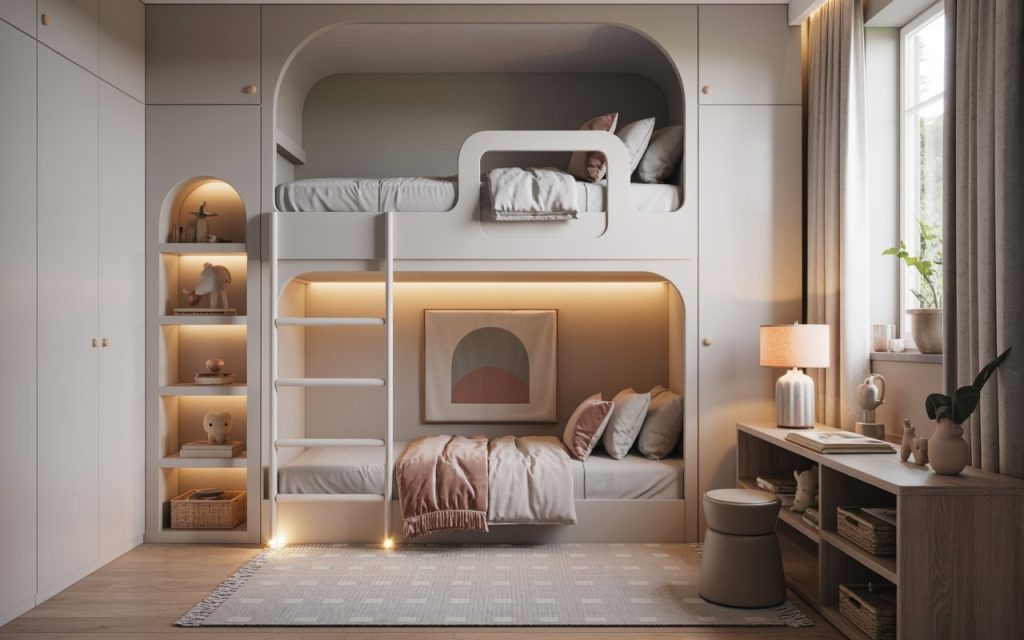

Bunk beds for kids can help families make better use of limited bedroom space, particularly when two children share a room. However, choosing a suitable design involves more than appearance: parents should check guardrails, ladder stability, frame strength, mattress thickness, age guidance and the manufacturer’s assembly instructions. In India, the Bureau of Indian Standards (BIS) lists a dedicated bunk-bed specification, IS 17636, making safety and standards verification important considerations when shopping.
News context: This is an informational buying guide, not a report of a newly announced product launch. A relevant Indian standards development is BIS’s December 16, 2025 notice granting an All India First Licence for bunk beds under IS 17636:2022.
Bunk Beds for Kids — Safety, Designs and What Parents Should Know
Introduction
Bunk beds for kids are a practical option for families who want to create more usable space in a shared bedroom. By placing one bed above another, these designs can free up floor space for a study table, toy storage, a reading corner or a play area. They are available in wooden and metal frames, compact layouts, storage-equipped models and designs with stairs instead of conventional ladders.
For Indian families, the buying decision also has a standards-related angle. On December 16, 2025, the Bureau of Indian Standards (BIS) issued a notice announcing an All India First Licence for bunk beds under Indian Standard IS 17636:2022. The notice identifies a licensee in Sonipat, Haryana. This is a verified standards-related development, although it should not be confused with an announcement of a new consumer product or a claim that every bunk bed sold in India is certified.
For parents, the priority is straightforward: choose a bunk bed that fits the room, suits the children’s ages and abilities, and has appropriate safety features. A stylish design or a low price should never outweigh stability, guardrails and correct assembly.
What Happened? BIS Issued a Bunk Bed Certification Licence Notice
BIS is India’s national standards body. Its December 2025 notice concerned the grant of an All India First Licence for bunk beds under IS 17636:2022.
The notice lists the following details:
- Product: Bunk beds
- Indian Standard: IS 17636:2022
- Licence number: 8530153813
- Licensee named in the notice: M/s Royal Safe Company KB
- Location: Rai Industrial Area, Sonipat, Haryana
- Notice date: December 16, 2025
These details come from the official BIS circular.
The development matters because a dedicated standard provides a technical reference for bunk-bed quality and safety. BIS material describes IS 17636 as covering performance and safety aspects such as strength, stability and durability. Its certification and standards resources can help consumers and businesses investigate product compliance.
However, the licence notice alone does not establish that every bunk bed available through online marketplaces, local furniture shops or custom furniture makers complies with the standard. Buyers should verify the particular manufacturer’s claims and the product’s certification details where applicable.
Key Details: What Parents Should Know Before Buying Bunk Beds for Kids
Choosing a bunk bed involves several practical considerations. The best model is not necessarily the tallest, most expensive or most elaborate. It is the one that matches the room, the users and the family’s needs.
1. Guardrails are essential on the upper bunk
Children can move around while sleeping, so the upper bunk needs effective protection against falls.
Look for guardrails on both sides, with secure attachment and sufficient height above the mattress. The guardrails should be compatible with the mattress thickness specified by the manufacturer. A thick mattress can reduce the effective height of a rail.
The US Consumer Product Safety Commission (CPSC) sets specific guardrail and entrapment requirements for bunk beds covered by its rules. Its guidance includes a requirement for the tops of guardrails to extend at least five inches above the top of the recommended mattress, along with detailed provisions for openings and rail placement. These are US requirements, not a substitute for checking applicable Indian requirements.
Parents should not assume that a decorative side panel is an adequate guardrail. Check the actual protective structure and the manufacturer’s instructions.
2. Consider the child’s age and ability
The upper bunk is not suitable for every child. The CPSC advises that children younger than six should not sleep on the upper bunk. Parents shopping in India can use this as a conservative safety guideline while also following the manufacturer’s age recommendations and any applicable local guidance.
Age is not the only consideration. A child may struggle with a ladder, have difficulty judging heights or climb around the frame during play. Consider whether the child can use the access system safely and consistently.
For younger children, a low bed or a separate floor-level sleeping arrangement may be a more appropriate choice. Do not select an upper bunk simply because the child is enthusiastic about having one.
3. Check ladder design and access
A bunk bed ladder should feel secure and provide clear access to the upper bunk. Before buying, check that:
- The ladder is firmly attached and does not wobble.
- Rungs provide a stable foothold.
- The ladder is positioned where the child can climb without obstruction.
- There is enough room to get on and off the bed safely.
- The ladder does not block a door, cupboard or main walking route.
Some models have stairs with handholds or built-in storage. These may be more convenient for some families, but stairs also occupy more room and need a stable, well-designed structure.
Whatever the design, children should be taught to climb carefully rather than jump from the upper bunk.
4. Match the mattress to the frame
A mattress must fit the bed frame properly. A mattress that is too small can leave gaps, while an excessively thick mattress can reduce guardrail protection.
Before ordering, confirm:
- The exact mattress dimensions required.
- The maximum permitted mattress thickness for the upper bunk.
- The type of mattress support the frame uses.
- The maximum load specified by the manufacturer.
Avoid assuming that two beds described as single-size will necessarily use identical mattress dimensions. Confirm the measurements in the product specifications.
5. Stability matters more than appearance
A bunk bed should remain stable during ordinary use. Inspect the frame, joints, bolts, fasteners and support structure. If the bed has a metal frame, check for damaged welds, exposed sharp edges or signs of corrosion. For wooden models, look for splits, loose joints and poorly finished surfaces.
Follow the assembly instructions and use the supplied hardware. Do not improvise structural repairs or replace essential fasteners with unsuitable alternatives.
If the manufacturer specifies wall anchoring, follow the instructions and use appropriate fixings for the wall type. A tall piece of furniture should not be installed on the assumption that its weight alone will prevent movement.
Background: Why Bunk Bed Safety Standards Matter
Bunk beds have been used for years in children’s bedrooms, hostels, camps and other shared sleeping spaces. Their space-saving design is useful, but the raised sleeping position and structural openings introduce risks that are different from those associated with a conventional bed.
One concern is entrapment. A child’s head, neck or body can become trapped in an unsuitable opening between structural components, guardrails, a mattress or a nearby wall. Another concern is falling from the upper bunk while sleeping or climbing.
The CPSC’s bunk-bed rules in the United States specifically address entrapment hazards, including gaps around guardrails and openings in the ends of bunk beds. Its requirements also address guardrail positioning and other construction details.
India has its own standards framework. BIS lists IS 17636 for bunk beds and provides resources for checking Indian standards and certification information. Its December 2025 licence notice is a concrete example of the standard being used in a certification context.
It is important to distinguish between a standard existing and a particular product being certified. A retailer’s description, a product photograph or a general statement that a bed is “strong” does not independently prove compliance. If a seller advertises BIS certification, request the relevant licence details and verify that they match the product and manufacturer.
What Types of Bunk Beds for Kids Are Available?
Different designs suit different rooms and family arrangements. The right choice depends on floor space, ceiling height, storage needs and how the beds will be used.
Wooden bunk beds

Wooden bunk beds are popular for their warm appearance and ability to suit a range of bedroom styles. Depending on construction, they may be made from solid wood, engineered wood or a combination of materials.
What to check: Ask about the material, frame construction, joint strength, finish and maintenance requirements. Do not assume that every wooden frame is solid wood or that wood automatically makes a bed safer.
Metal bunk beds

Metal frames can provide a clean, simple appearance and may suit compact rooms. Their quality depends on the design, material, connections and manufacturing.
What to check: Look for a stable frame, secure joints, smooth edges and a ladder that does not shift under normal use. Ask the seller about the load limits and finish.
Bunk beds with storage

Storage-equipped models may include drawers, shelves or compartments beneath the lower bed. They can help reduce clutter in smaller rooms.
What to check: Measure the space needed to open drawers fully. Make sure storage access does not obstruct the ladder or create a tripping hazard. Keep heavy items in suitable locations rather than placing loose objects near the upper bunk.
Bunk beds with stairs

Some bunk beds use a staircase instead of a narrow ladder. This can make access more comfortable for certain users, although the stairs may take up additional floor space.
What to check: Look at the width and depth of each step, handholds, stability and the amount of room required. Stairs should not be treated as a reason to allow a child who is too young to use the upper bunk.
L-shaped and loft bunk beds

L-shaped arrangements place the sleeping surfaces at an angle, while loft beds raise one sleeping area to create usable space underneath. Depending on the design, the lower area can accommodate a desk, storage or another piece of furniture.
What to check: Measure the complete footprint, not just the mattress dimensions. Pay attention to ceiling clearance, overhead fans, lights and access to windows. Ensure the raised bed’s protective features are suitable for its intended use.
Images are illustrative examples of common designs, not endorsements of particular products or evidence of safety certification.
What Officials and Organizations Say About Bunk Bed Standards
The official BIS circular dated December 16, 2025, confirms that an All India First Licence was granted for bunk beds under IS 17636:2022. The circular names the licence holder and identifies the product standard.
BIS also provides a “Know Your Standard” service through which users can search for information about standards, related documents and certification resources. This is a useful starting point for checking claims made by a furniture seller.
Separately, the US CPSC explains that its bunk-bed rules are designed to address risks such as children becoming trapped in openings around the bed structure. Its guidance describes requirements for guardrails and openings. These US rules offer useful background on common hazards, but they should not be presented as Indian law.
The practical takeaway is that parents should seek verifiable product information rather than rely only on a seller’s marketing language. If the product is advertised as certified, ask for the certification details. If the listing does not provide enough information about the frame, mattress limits or guardrails, request clarification before purchasing.
Why This Matters for Indian Families
Many families want a bedroom to serve several purposes: sleeping, studying, reading, storing toys and playing. Bunk beds can make this easier by using vertical space instead of requiring two separate beds across the floor.
But the space-saving benefit should be considered alongside the room’s layout and the child’s needs.
Measure the room before choosing a design
Measure the available floor area, ceiling height and the position of doors, windows, wardrobes, lights and fans. Allow enough room for the ladder or stairs and for a child to enter and leave the bed comfortably.
A tall bed may fit on paper but still be unsuitable if the upper sleeper is too close to a ceiling fan or light fitting. The top bunk also needs enough clearance for a child to sit up without striking the ceiling or another obstruction.
Think about the children sharing the bed
Siblings may have different ages, heights, sleeping habits and physical abilities. A bunk bed should work for both children rather than simply fit the room.
Consider whether the children are comfortable sharing a bedroom, whether they can follow the rules for climbing and whether the lower bed offers enough space for the younger child. A separate low bed may be the better option if one child is not ready for an upper bunk.
Check the full cost
The advertised price may not include mattresses, delivery, assembly, wall anchoring or additional storage accessories. Ask the seller what is included before comparing prices.
A cheaper product may not offer the dimensions, materials or support features your family needs. Compare the complete specifications and after-sales support, not only the headline price.
What Happens Next? A Practical Buying Checklist
No further product launch or policy change is established by the BIS licence notice alone. For consumers, the useful next step is to check the product carefully before placing an order.
Use this checklist when shopping for bunk beds for kids:
- Confirm the bed’s dimensions and whether it fits the room.
- Check the recommended age and maximum load.
- Inspect the upper-bunk guardrails and their attachment.
- Confirm the mattress size and maximum thickness.
- Check the ladder or stairs for stability and ease of access.
- Look for smooth edges, secure joints and a sturdy support structure.
- Follow the manufacturer’s assembly and maintenance instructions.
- Ask whether wall anchoring is required.
- Verify any claimed BIS certification or licence details.
- Review delivery, assembly, warranty and return terms.
After assembly, periodically check fasteners and joints as directed by the manufacturer. Stop using the bed if you discover a cracked component, a loose guardrail or a structural problem until it has been properly assessed and repaired.
Conclusion
Bunk beds for kids can be a useful solution for shared bedrooms and compact homes, but the best purchase combines thoughtful design with careful attention to safety. Wooden, metal, storage-equipped and staircase models all have potential advantages; none should be chosen on appearance alone.
India’s BIS notice of December 2025 confirms a bunk-bed licence under IS 17636:2022, highlighting the importance of product standards and verifiable manufacturer information. Parents should still check the certification claims, dimensions, guardrails, mattress requirements and age guidance for the specific bed they plan to buy.
A well-chosen bed should make the bedroom more functional without compromising safe access, adequate clearance or the needs of the children who will use it.
Frequently Asked Questions
1. Are bunk beds for kids safe?
They can be suitable when the design is appropriate for the children, the frame is stable, guardrails are effective and the bed is assembled according to the manufacturer’s instructions. Parents should also follow age recommendations and supervise safe use.
2. What age is suitable for the upper bunk?
The US CPSC advises that children under six should not sleep on the upper bunk. Parents should also consider the child’s climbing ability, maturity and the manufacturer’s guidance.
3. What is the Indian standard for bunk beds?
BIS lists IS 17636 for bunk beds. A BIS circular dated December 16, 2025, records the grant of an All India First Licence for bunk beds under IS 17636:2022. Buyers should verify any certification claim against the specific product and manufacturer.
4. Are wooden bunk beds better than metal bunk beds?
Neither material is automatically better or safer. Compare frame construction, stability, workmanship, guardrails, finish, load limits, maintenance needs and the manufacturer’s product information.
5. Are bunk beds suitable for small bedrooms?
Yes, they can free up floor space by stacking sleeping areas vertically. However, you should measure the room’s floor area and ceiling height and check clearance around fans, lights, doors, windows and the ladder.
6. Are bunk beds with stairs safer than those with ladders?
Stairs may provide a different and sometimes more comfortable way to access the upper bed, but safety depends on the full design, including step dimensions, handholds, stability and guardrails. Stairs do not remove the need to follow age recommendations.
7. What mattress should I buy for a bunk bed?
Choose a mattress that matches the frame’s specified dimensions. Check the manufacturer’s maximum mattress thickness for the upper bunk so the mattress does not reduce the effective height of the guardrails.
8. What should I check before buying a bunk bed online in India?
Review the dimensions, materials, load limits, age recommendations, guardrails, ladder design, mattress specifications, assembly instructions and warranty. If the listing claims BIS certification, ask for the relevant details and verify that they apply to the model being sold.