
Home Preschool vs Commercial Preschool is essentially a comparison between learning in a home-based, usually smaller setting and attending an organized preschool operating in a dedicated institutional or commercial setting. Home preschool can offer a familiar environment, smaller groups and greater flexibility, while a commercial preschool may provide more structured routines, classroom resources and opportunities for children to interact with larger peer groups. There is no universally better option—the quality of the teacher, safety, learning approach, class size and individual needs of the child matter more than the setting alone.
Home Preschool vs Commercial Preschool: What’s the Difference?
Choosing a preschool is one of the first major education decisions many parents make. For families with children around the preschool years, the question is no longer simply whether a child should start early learning. Parents are increasingly comparing different formats, including home preschool vs commercial preschool, to determine which environment will provide the right balance of learning, social development, comfort and independence.
The terminology can sometimes be confusing. A “home preschool” generally refers to early learning delivered in a home environment, either by a parent/caregiver or by a small home-based provider. A commercial preschool generally refers to an organized preschool or early-learning center operating from a dedicated facility and serving a group of children.
The difference is therefore not simply about the building. It can affect class size, daily routines, social interaction, resources, flexibility and the way learning activities are organized.
India’s National Education Policy (NEP) 2020 places strong emphasis on Early Childhood Care and Education (ECCE), particularly for children from age 3 onward. The policy recommends play-based, activity-based and inquiry-based learning rather than relying only on formal academic instruction.
What Is a Home Preschool?
A home preschool is an early-learning arrangement conducted primarily in a home setting.
It can take several forms. Parents may create a structured preschool routine at home themselves, or a trained caregiver or small home-based provider may teach a small group of children in a residential environment.
The key characteristic is the home-like setting and relatively small-scale environment.
Children may learn through:
- Storytelling
- Drawing and coloring
- Puzzles
- Songs and rhymes
- Counting games
- Alphabet activities
- Sensory play
- Art and crafts
- Building activities
- Outdoor play
- Practical everyday tasks
India’s National Curriculum Framework for the Foundational Stage recognizes the importance of the home environment in early childhood. It describes the period up to age 3 as primarily home-based, while noting that after age 3, children increasingly spend time in organized settings such as Anganwadis and preschools.
That does not mean every child must attend a commercial preschool after age 3. Rather, it highlights the importance of combining appropriate learning, care and stimulation at home with suitable institutional opportunities when appropriate.
What Is a Commercial Preschool?
A commercial preschool generally operates as an organized early-learning center rather than as a private household learning environment.
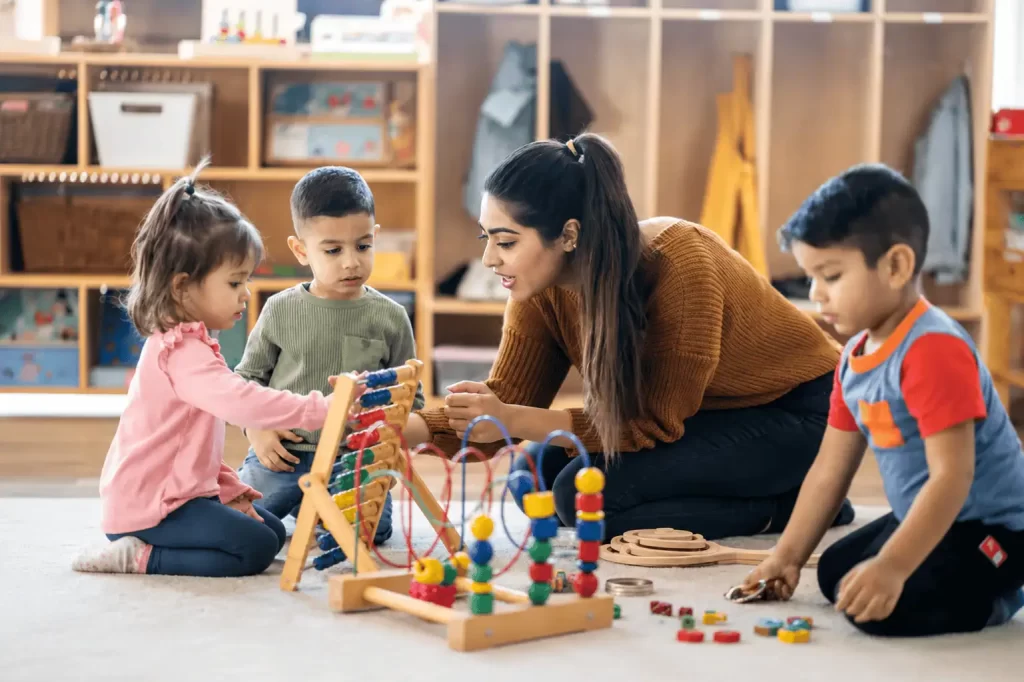
Children usually attend according to a defined schedule and participate in activities planned by teachers or educators. The preschool may have separate classrooms, play areas, teaching materials and age-based groups.
Center-based childcare programs commonly organize children into groups or classrooms and have multiple staff members under the supervision of a director or administrator.
Depending on the preschool, children may participate in:
- Circle time
- Story sessions
- Art and craft
- Music and movement
- Phonics activities
- Number and counting activities
- Free play
- Group games
- Outdoor activities
- School-readiness activities
- Social and communication activities
However, parents should not assume that every commercial preschool provides high-quality education simply because it has a large building or recognizable name.
The quality of the program matters more than the label.
Home Preschool vs Commercial Preschool: Key Differences
The easiest way to understand the two options is to compare the major factors parents normally consider.
| Factor | Home Preschool | Commercial Preschool |
|---|---|---|
| Environment | Home-like and familiar | Dedicated classroom environment |
| Group size | Often smaller | Often larger |
| Flexibility | Usually higher | Usually follows a fixed schedule |
| Social interaction | Can be limited | Usually more opportunities with peers |
| Resources | Depends on the provider/family | Often wider range of classroom materials |
| Routine | Can be customized | Generally structured |
| Teacher consistency | May be high if one caregiver teaches | May involve multiple teachers/staff |
| Independence | Can develop gradually | Group routines may encourage independence |
| Parent involvement | Usually high | Depends on the school |
| Cost | Can be lower, but varies | Varies considerably by school |
| School-like experience | Limited | Usually stronger |
| Convenience | Potentially very convenient | Depends on location and transport |
These differences are general patterns, not guarantees. A small, well-run preschool can provide excellent learning, while a poorly organized home program may not meet a child’s needs.
1. Learning Environment
One of the biggest differences in home preschool vs commercial preschool is the physical environment.
A home preschool can feel familiar and less institutional. For some children, this environment may make the transition into early learning easier.
A commercial preschool usually provides a space specifically designed for groups of young children. It may have dedicated classrooms, learning corners, books, toys, activity materials and outdoor play areas.
ChildCare.gov notes that families may choose center-based programs because they appreciate structured classroom environments and the variety of equipment, supplies and activities that centers can offer.
But more equipment does not automatically mean better education.
A preschool should use materials purposefully and give children opportunities to explore, communicate and play.
2. Class Size and Individual Attention
Home-based programs can have a smaller number of children.
That can make it easier for an educator to notice an individual child’s interests, communication style and learning pace.
Family child care homes, for example, are specifically described by ChildCare.gov as serving small groups of children and offering a home-like setting.
Commercial preschools may have larger groups, although the actual class size varies widely.
A larger group can provide valuable peer interaction, but parents should ask about:
- Number of children in the classroom
- Number of teachers
- Adult-to-child ratio
- How individual children receive attention
- How teachers handle conflicts
- Whether children are separated by age
Small class size is useful, but teacher quality remains critical.
3. Socialization and Peer Interaction
This is one area where commercial preschools can have a natural advantage.
Children regularly interact with other children of similar ages. They learn to:
- Take turns
- Share materials
- Listen to others
- Follow group routines
- Communicate needs
- Cooperate during activities
- Resolve simple disagreements
A home preschool can also provide socialization if children participate in playgroups, community activities, parks, library programs or small group classes.
So the real question is not simply home or school.
The question is:
Does the child have enough meaningful opportunities to interact with other children?
4. Flexibility
Home preschool can be more flexible.
Parents may be able to adjust activities according to a child’s interests, energy level or daily routine.
For example, if a child becomes fascinated by animals, the day’s learning could revolve around animal stories, counting animals, drawing animals and learning animal sounds.
Commercial preschools generally operate according to a timetable.
That structure can also be beneficial. Children learn that certain activities happen at predictable times, which can support routine and independence.
Neither approach is automatically better.
Some children thrive with flexibility, while others benefit from predictable routines.
5. Learning Through Play
Modern early-childhood education increasingly emphasizes play and development rather than pushing young children into overly formal academic work.
India’s NEP 2020 recommends flexible, play-based, activity-based and inquiry-based learning for ECCE. It identifies areas such as language, numbers, colors, shapes, puzzles, problem-solving, art, music, movement, teamwork and communication as components of early childhood learning.
This means parents should look beyond questions such as:
“How many letters will my child learn?”
Instead, ask:
“How does the preschool help my child communicate, explore, think, play and solve problems?”
A strong home preschool and a strong commercial preschool can both use play-based learning effectively.
6. Resources and Activities
Commercial preschools may have access to a wider range of classroom resources.
These can include:
- Blocks
- Manipulatives
- Art supplies
- Books
- Dramatic-play materials
- Outdoor equipment
- Musical instruments
- Puzzles
- Classroom displays
- Age-specific learning resources
A home preschool may have fewer resources, but that does not necessarily limit learning.
Everyday household objects can become learning materials.
For example:
- Measuring cups can introduce basic mathematical concepts.
- Kitchen objects can support vocabulary.
- Laundry sorting can become a classification activity.
- Household books can support language development.
- Building blocks can encourage spatial thinking.
The important factor is how materials are used, not how expensive they are.
7. Teacher Qualifications and Quality
This may be the most important factor in the entire comparison.
Parents should not select a preschool simply because it is home-based or commercial.
Instead, investigate the person responsible for teaching and caring for the child.
Ask:
- What training does the educator have?
- Does the teacher understand early childhood development?
- How are children supervised?
- How are behavioral issues handled?
- Is learning age-appropriate?
- Does the program encourage play?
- Are children allowed to ask questions?
- How does the teacher communicate with parents?
India’s NEP 2020 specifically envisions ECCE being delivered by institutions with workers and teachers specially trained in ECCE curriculum and pedagogy.
8. Safety and Health
Safety should be a non-negotiable factor regardless of the preschool format.
For a home preschool, parents should inspect:
- Stairways
- Electrical outlets
- Kitchen access
- Bathrooms
- Furniture
- Toys
- Outdoor areas
- Entry and exit arrangements
- Emergency procedures
For a commercial preschool, parents should ask about:
- Building safety
- Fire safety
- Child pickup procedures
- Visitor access
- Teacher supervision
- First-aid arrangements
- Emergency contacts
- Hygiene practices
- Outdoor play safety
Licensing and regulatory requirements differ by country and jurisdiction, so parents should check the rules applicable to their location rather than assuming that every home or commercial program has the same legal requirements.
9. Cost
Cost is another important consideration, but there is no universal rule that home preschool is always cheaper.
A parent-led home preschool can cost very little because the family may already have books, toys and household materials.
A paid home-based provider may charge a fee.
Commercial preschools can have significant tuition and additional costs such as:
- Registration
- Transportation
- Uniforms
- Activity fees
- Learning materials
- Events
- Extended-care services
Therefore, parents should compare the total annual cost, not just the advertised monthly fee.
What Does India’s Education Policy Say About Preschool?
India’s education framework gives early childhood education a much stronger role than it traditionally received.
The National Education Policy 2020 places children aged 3–8 within the Foundational Stage and emphasizes early childhood care and education as the foundation of later learning.
The policy calls for ECCE to include areas such as:
- Physical and motor development
- Cognitive development
- Socio-emotional development
- Communication
- Early language and literacy
- Early numeracy
- Art and culture
- Teamwork and cooperation
It also recognizes several forms of early-childhood institutions, including Anganwadis, pre-primary sections and stand-alone preschools.
This is important because it shows that the central issue is not whether a child learns in a particular type of building.
The focus is on access to quality early childhood care and education.
What Parents Should Check Before Choosing a Preschool
Whether you choose a home preschool or a commercial preschool, visiting the program is one of the best ways to evaluate it.
ChildCare.gov recommends visiting childcare settings in person so parents can observe how the program operates, see the learning and play spaces, and watch how teachers interact with children.
During the visit, parents should ask:
Learning
- Is the curriculum play-based?
- Are children given time for free play?
- Are activities appropriate for their age?
- Is there excessive worksheet or memorization work?
Teachers
- Are teachers trained in early childhood education?
- Do they speak respectfully to children?
- Do they listen to children’s questions?
- How many children does each adult supervise?
Safety
- Is the environment clean and child-friendly?
- Are emergency procedures explained?
- Who is authorized to collect the child?
- How are accidents handled?
Emotional Development
- Are children encouraged to express feelings?
- How are crying and separation anxiety handled?
- Are children pressured or punished for normal developmental behavior?
Parent Communication
- How frequently do parents receive updates?
- Can parents discuss concerns with teachers?
- Are developmental observations shared?
Home Preschool vs Commercial Preschool: Which Is Better?
There is no single answer.
Home preschool may be a good fit when:
- The child benefits from a familiar environment.
- Parents want a smaller learning group.
- The family wants greater flexibility.
- A qualified and trustworthy educator is available.
- The child still has regular opportunities for peer interaction.
Commercial preschool may be a good fit when:
- The child enjoys group activities.
- Parents want a structured daily routine.
- The child needs regular peer interaction.
- The preschool provides qualified teachers.
- The facility offers safe, developmentally appropriate activities.
- The family wants a more school-like transition.
The strongest choice is the environment where the child is safe, cared for, engaged and encouraged to learn through developmentally appropriate experiences.
What Officials and Education Organizations Emphasize
India’s Ministry of Education emphasizes quality ECCE and describes play-based, activity-based and inquiry-based learning as important components of early childhood education.
The National Curriculum Framework for the Foundational Stage similarly describes the first eight years as critical for children’s physical, cognitive and socio-emotional development and recognizes both home and institutional environments as important parts of early childhood.
Internationally, ChildCare.gov’s guidance also emphasizes that families should look for programs that provide safe, healthy and supportive environments with nurturing relationships and opportunities for children to learn and explore.
Together, these sources point toward a useful conclusion: the quality of the child’s experience matters more than whether the preschool is located in a home or a commercial facility.
Why This Difference Matters for Parents
The preschool years are not simply preparation for exams.
They are a period when children develop communication, motor abilities, social skills, emotional understanding, curiosity and early concepts about language and mathematics.
That is why parents should avoid judging a preschool only by:
- The number of worksheets
- Fancy classrooms
- Expensive uniforms
- English-only instruction
- The size of the building
- Marketing claims
- The number of activities listed in a brochure
Instead, look at what children actually do during the day.
Are they playing?
Are they talking?
Are they asking questions?
Are teachers responding patiently?
Are children moving, creating and exploring?
Are they learning to cooperate?
Those observations can tell parents much more about preschool quality.
What Happens Next for Parents Choosing Between the Two?
There is no official requirement that every family choose either a home preschool or a commercial preschool simply because of the format.
The practical next step is to compare individual programs.
Parents should visit their preferred options, check applicable local regulations, speak with teachers, observe the environment and consider their child’s personality and developmental needs.
For families in India, the broader policy direction is clear: early childhood education is an important part of the Foundational Stage, with an emphasis on quality, play-based and developmentally appropriate learning.
Frequently Asked Questions
1. What is the difference between home preschool and commercial preschool?
A home preschool operates in a home-like environment and often serves a smaller group, while a commercial preschool generally operates from a dedicated facility with organized classrooms, teachers and scheduled activities. The exact structure varies from one provider to another.
2. Is home preschool better than commercial preschool?
Not necessarily. Home preschool can provide flexibility and a smaller environment, while commercial preschool may offer greater peer interaction, structured routines and more classroom resources. The quality of care and teaching is more important than the setting itself.
3. What age is preschool appropriate for?
In India’s education framework, the Foundational Stage covers ages 3–8, and NEP 2020 places strong emphasis on ECCE from age 3.
4. Does a child need preschool at age 3?
Families have different circumstances and options. However, India’s education policy identifies quality early childhood care and education from around age 3 as an important foundation for later learning.
5. Is home learning enough for preschool children?
Home learning can provide valuable language, play, problem-solving and early academic experiences. However, children also benefit from opportunities for social interaction and varied experiences. Families should consider how those needs will be met.
6. What should parents look for in a good preschool?
Parents should look for a safe environment, caring and appropriately trained educators, developmentally suitable activities, opportunities for play and exploration, manageable group sizes, positive teacher-child interactions and good communication with families.
7. Are commercial preschools more expensive than home preschools?
Not always. Costs vary significantly by location, provider, hours, facilities and services. A home-based arrangement may be inexpensive if parents provide the learning themselves, while a paid home program can have its own fees.
8. Should preschool focus heavily on reading and writing?
Early literacy and numeracy are important, but India’s ECCE framework emphasizes a broader approach that includes play, language, cognitive development, movement, art, social development and problem-solving.