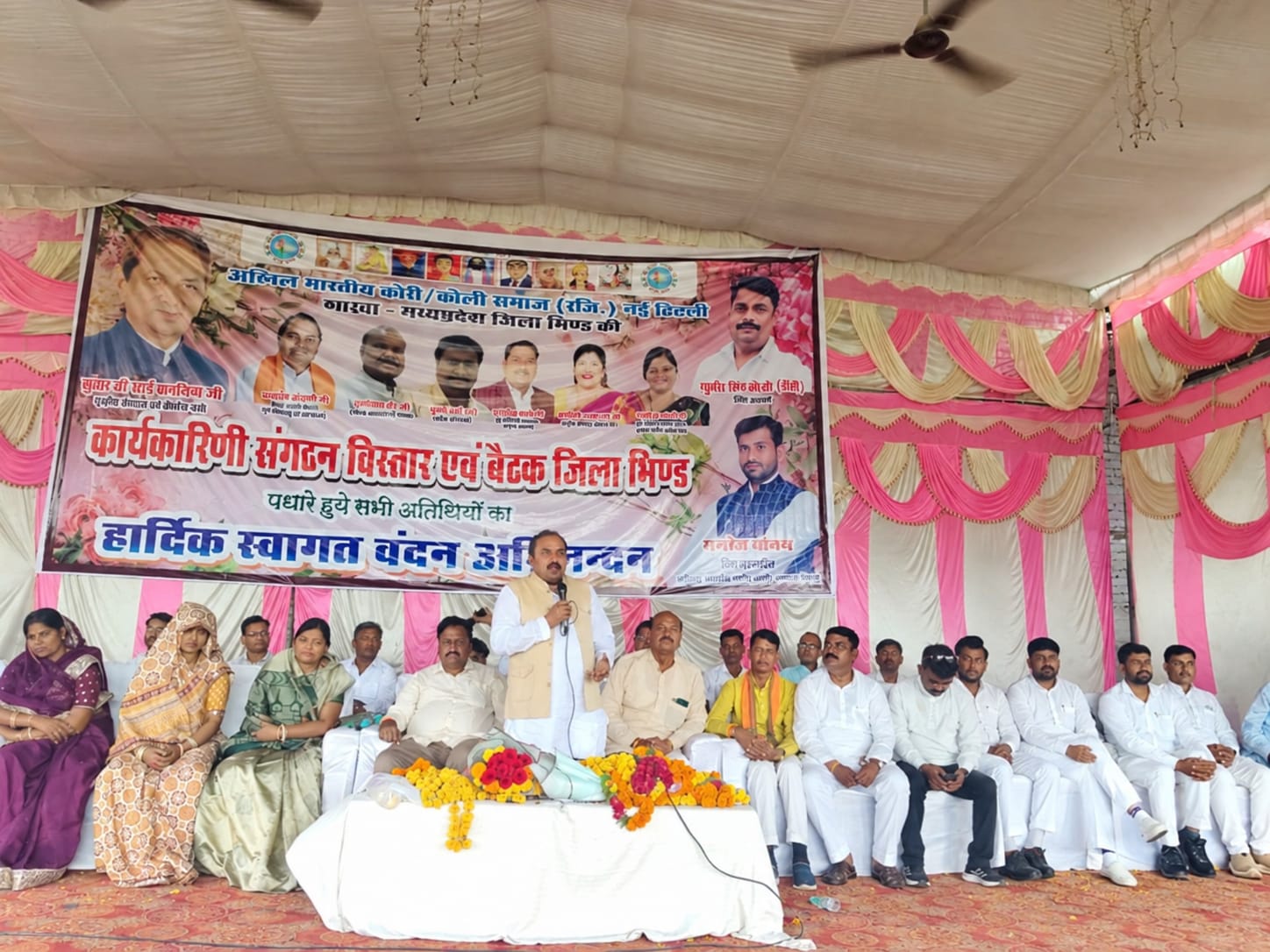

A Kori-Koli community meeting in Bhind has been associated with discussions about strengthening community organization and giving greater importance to education and social development. A directly relevant Bhind report available from Dainik Bhaskar documents a Kori-Koli society meeting held at BTI Road at the residence of community president Sandeep Koli, where organizational preparations and a larger divisional-level Jhalkari Bai Jayanti programme were discussed.
More recent reporting from Madhya Pradesh and Uttar Pradesh shows that education, community organization and expansion of local units remain recurring themes in Kori-Koli community meetings.
Introduction
Education and community organization have emerged as recurring priorities in meetings held by Kori-Koli community groups in different parts of North and Central India. In Bhind, Madhya Pradesh, a reported Kori-Koli society meeting brought community members together to discuss organizational activities and preparations for a larger social programme.
The Bhind report is particularly relevant because it shows how local community organizations use meetings not only for cultural programmes but also to discuss collective participation and organizational activity.
The exact date of the Bhind meeting referenced in the available report is not clearly established in the currently accessible source, so it should not be described as a newly held 2026 event without additional confirmation. What can be established is that the meeting took place at the residence of Kori-Koli society president Sandeep Koli on BTI Road in Bhind and involved senior members of the community.
The broader discussion is also consistent with more recent Kori-Koli community activity in Madhya Pradesh and Uttar Pradesh, where education, organizational expansion and greater participation have featured in community meetings.
What Happened?
The Bhind meeting was organized by the Kori-Koli community at the BTI Road residence of its president, Sandeep Koli, according to a Dainik Bhaskar report.
One of the major subjects discussed was the organization of a divisional-level celebration of Veerangana Jhalkari Bai Jayanti. The report said the community planned to organize the celebration at the divisional level rather than limiting it to the district.
Sandeep Koli discussed the preparations, while Akhil Bharatiya Kori-Koli Samaj Madhya Pradesh president Raghuveer Singh Koli also addressed the gathering. The report highlighted Jhalkari Bai’s historical contribution and said organizational preparations were underway for the larger programme.
Although the available Bhind report focuses more directly on community organization and the proposed cultural programme than on a detailed education agenda, education has become a recurring theme in Kori-Koli community discussions elsewhere.
That distinction is important. The headline’s emphasis on education and organization reflects the broader pattern of community discussions, but the available Bhind source does not provide enough evidence to attribute a detailed education resolution or specific education scheme to that particular meeting.
Key Details
The available reporting establishes several important points:
- The meeting was organized by the Kori-Koli community in Bhind.
- It was held at the BTI Road residence of community president Sandeep Koli.
- Community members discussed organizational preparations for Veerangana Jhalkari Bai Jayanti.
- The proposed celebration was described as a divisional-level programme, rather than only a district-level event.
- Raghuveer Singh Koli, identified in the report as state president of the Akhil Bharatiya Kori-Koli Samaj, was among those involved.
- The gathering included senior members of the community.
- Recent Kori-Koli meetings in other areas have also placed emphasis on education and stronger organizational structures.
Education as a Community Development Priority
Education frequently appears in community development discussions because it can influence access to employment, higher education, professional opportunities and government services.
A recent meeting reported in Uttar Pradesh illustrates this emphasis. In September 2025, Hindustan reported that the Uttar Pradesh unit of the Akhil Bharatiya Koli (Kori) Samaj discussed expanding its organization across the state’s districts. The meeting took place at the Ambedkar Mahasabha auditorium in Lucknow and included senior office-bearers of the organization.
Another Kori community meeting reported by Dainik Bhaskar in Deoband specifically called for greater attention to children’s higher education. Community representatives also encouraged young people to participate in social development and urged families to ensure that children receive education and remain connected with the community.
These reports indicate that education is not simply being discussed as a school-related issue. Within these community organizations, it is often presented as part of a wider strategy involving youth participation, social awareness and economic opportunity.
Stronger Organization Is Another Recurring Theme
Organization has also been a central theme in recent Kori-Koli community activity.
In September 2025, Hindustan reported that the Uttar Pradesh Koli (Kori) Samaj discussed establishing organizational units in districts across the state. The stated objective was to expand the community’s organizational network.
A separate report from Madhya Pradesh described a Kori-Koli social harmony meeting where participants discussed educational, social and organizational issues. The report said speakers emphasized greater organizational activity and also discussed giving education greater priority.
More recently, a September 2026 report from Rewa described an Akhil Bharatiya Kori-Koli Samaj divisional meeting where participants discussed expanding the organization’s structure from the district level to tehsil and panchayat levels.
This provides useful context for understanding why community meetings can focus heavily on organization. A stronger local network can make it easier for members to communicate information, organize educational activities and coordinate community programmes.
What the Bhind Meeting Shows
The Bhind meeting is significant primarily as an example of local community organization.
The reported decision to work toward a divisional-level Jhalkari Bai Jayanti programme suggests an effort to bring people together beyond a single locality. Community celebrations can serve a cultural purpose, but they can also create opportunities for networking and collective discussion.
At the same time, it would be inaccurate to claim that the Bhind meeting itself created a new education policy or launched a specific scholarship or educational programme. No such initiative is documented in the source reviewed for this article.
That distinction matters when reporting community news. A discussion about education is different from the launch of an education programme, and a proposal is different from a confirmed implementation.
Background: Kori and Koli Communities in Madhya Pradesh
Government census records provide useful demographic and educational context.
The Census of India includes Koli, Kori among the Scheduled Caste categories recorded for Madhya Pradesh. The 2011 Census educational tables include Koli/Kori as a community category and provide data relating to educational participation and educational attainment.
The Census also maintains district-level educational information for Scheduled Caste communities, including Bhind. The available Bhind data includes categories such as literacy, primary education, secondary education and graduate-level education.
However, these are census datasets from earlier years and should not be interpreted as a current measurement of the community’s educational situation in 2026.
They are useful mainly because they demonstrate that educational attainment has long been an important measurable component of social development.
What Community Organizations Have Said
Recent community meetings show that education and organizational participation are recurring subjects.
In a 2025 Uttar Pradesh meeting, community representatives discussed creating organizational units across districts.
In another meeting reported from Madhya Pradesh, participants discussed educational issues alongside organizational activity. The report said speakers called for education to receive greater attention and mentioned the possibility of an education-and-jobs seminar.
A separate Deoband meeting focused more directly on children’s education. Speakers encouraged families to pay special attention to children’s education and called on young people to participate in bringing social change.
Together, these reports show a recurring pattern: community organizations are discussing education alongside organizational participation rather than treating the two as completely separate issues.
Why This Matters
The emphasis on education is important because educational opportunities can affect a person’s ability to pursue higher studies, vocational training and employment.
For community organizations, the challenge is turning broad calls for education into practical support.
That could include activities such as:
- Helping students understand available scholarships and educational schemes.
- Providing information about admission procedures.
- Encouraging students to complete secondary and higher secondary education.
- Supporting career guidance for young people.
- Creating mentoring networks.
- Encouraging families to prioritize children’s education.
- Connecting students with information about competitive examinations and vocational opportunities.
The available reports do not establish that all of these activities are currently being carried out by the Bhind organization. They are examples of the practical areas that commonly follow from an education-focused community agenda.
Organizational strength can also matter because information and support often reach families more effectively when there is an active local network.
The Role of Young People
Youth participation has been another recurring theme in community discussions.
The Deoband meeting, for example, included a direct appeal for young people to come forward and contribute to social change.
Youth participation can take many forms, including volunteering, educational mentoring, organizing local events and helping families access information.
For community organizations, involving younger members can also create continuity between current leadership and future generations.
However, participation needs to translate into practical programmes if organizations want their educational goals to produce measurable outcomes.
Cultural Events and Community Organization
The Bhind meeting also highlights the role of cultural and historical events in community organization.
The reported plan to organize Jhalkari Bai Jayanti at the divisional level provides a common occasion for community members to gather and participate.
Such events can have cultural significance while also providing an opportunity for members from different areas to interact.
The Bhind report specifically connected the event with organizational preparations. That makes the meeting relevant not only as a cultural gathering but also as an example of community-level coordination.
What Happens Next?
For the Bhind-specific event, the available source indicates that preparations were being made for a divisional-level Jhalkari Bai Jayanti programme. The source does not provide enough current information to confirm the final date, venue, attendance or outcome of that proposed programme.
Similarly, there is no verified information in the sources reviewed establishing that the Bhind meeting resulted in a new scholarship, school, educational trust or formal education programme.
The broader organizational trend is clearer. Recent reports show Kori-Koli organizations discussing expansion of local structures and continuing to emphasize education and community participation.
Whether those discussions lead to sustained educational programmes will depend on implementation, funding, participation and coordination at the local level.
Conclusion
The Kori-Koli community meeting in Bhind reflects a broader pattern of community organizations using local gatherings to strengthen social connections, discuss organizational activity and promote community development.
The directly available Bhind report focuses particularly on plans for a divisional-level Jhalkari Bai Jayanti programme and the participation of community leaders.
More recent reports from Madhya Pradesh and Uttar Pradesh show that education and organizational expansion continue to feature prominently in Kori-Koli community discussions.
For readers, the most important distinction is between what has been formally reported and what remains a broader community goal. Education, youth participation and stronger organization are recurring priorities, but specific future programmes in Bhind should be confirmed through official community announcements or reliable local reporting.
Frequently Asked Questions
1. What was the Kori-Koli community meeting in Bhind about?
The available Bhind report says the meeting focused on community organization and preparations for celebrating Veerangana Jhalkari Bai Jayanti at the divisional level.
2. Where was the Bhind Kori-Koli meeting held?
The reported meeting was held at the residence of Kori-Koli society president Sandeep Koli on BTI Road in Bhind.
3. Who participated in the Bhind meeting?
The report identifies Sandeep Koli and Raghuveer Singh Koli among those involved and says several senior community members were present.
4. Was education discussed at the Bhind meeting?
The available Bhind report does not provide enough detail to confirm a specific education resolution from that meeting. Education is, however, a recurring priority in other recent Kori-Koli community meetings in Madhya Pradesh and Uttar Pradesh.
5. Why is education important in Kori-Koli community discussions?
Community representatives in recent meetings have linked children’s education and higher education with broader social development and encouraged families and young people to give education greater attention.
6. Are Kori-Koli organizations expanding their local networks?
Recent reporting indicates organizational expansion has been discussed. In Uttar Pradesh, a 2025 meeting discussed establishing organizational units across districts, while a 2026 Rewa report described plans for organization at district, tehsil and panchayat levels.
7. What is the significance of Jhalkari Bai Jayanti in the Bhind report?
The Bhind report says the community planned to organize the celebration at the divisional level and described Jhalkari Bai’s contribution to India’s freedom struggle as a reason for commemorating her.
8. Is there a new education scheme announced by the Bhind Kori-Koli community?
No specific new scholarship, school or education scheme could be verified from the Bhind report reviewed for this article. Claims about a new programme should be confirmed through an official announcement or reliable local report before being treated as established fact.